DCAP-BTLS for EMTs: What Each Letter Means and Where It Fits in the Trauma Assessment
Last updated: November 25, 2026
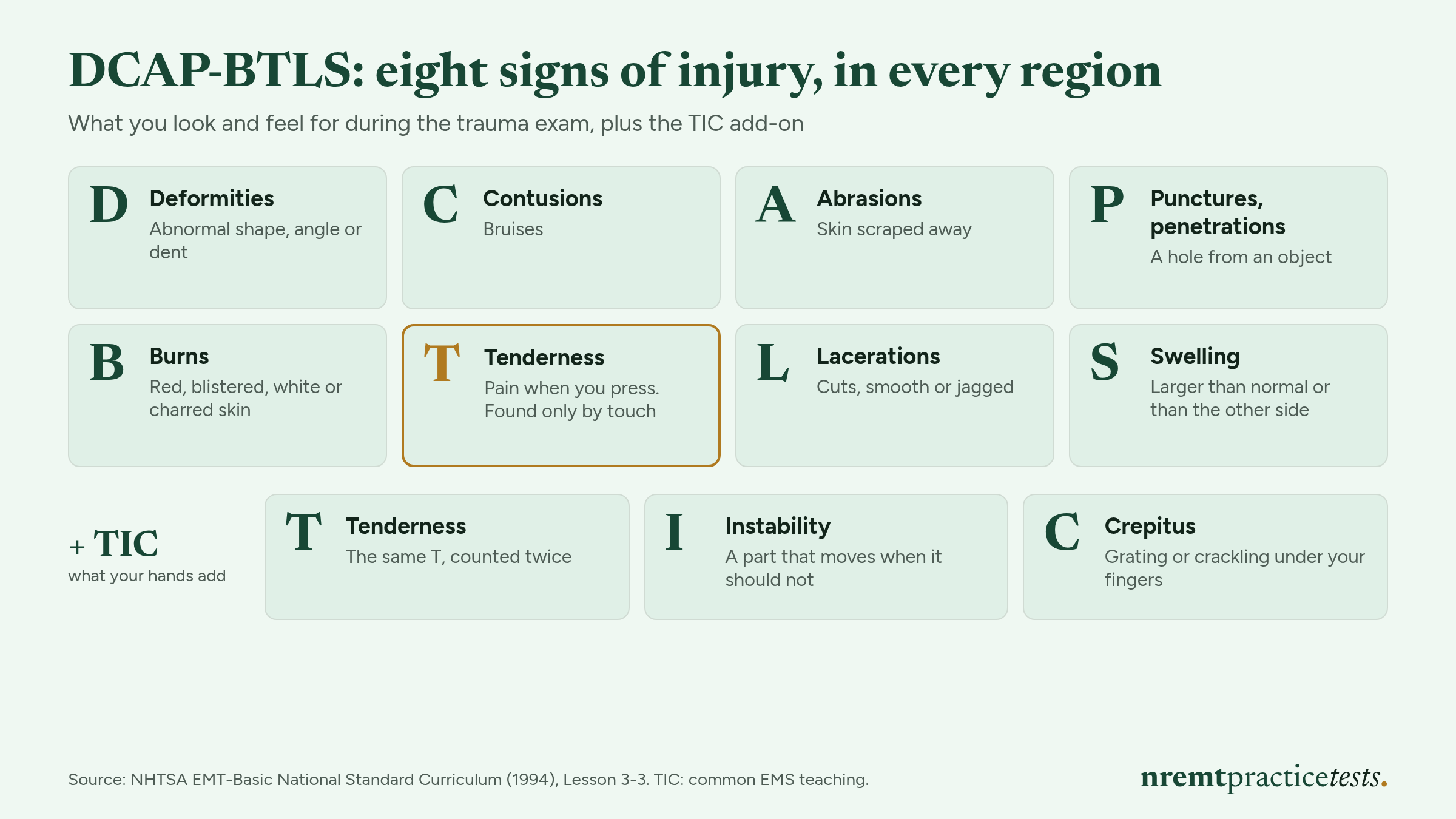
DCAP-BTLS is the list of eight injury signs an EMT looks and feels for in every body region: deformities, contusions, abrasions, punctures or penetrations, burns, tenderness, lacerations and swelling. TIC adds tenderness, instability and crepitus. The eight come straight from the trauma lesson of the 1994 EMT-Basic National Standard Curriculum, which lists them under the head, neck, chest, abdomen, pelvis and limbs and adds a few extra checks for each region (NHTSA, Lesson 3-3, PDF).
Most quick references stop at the letters. This guide adds what each region adds to them, what the National Registry trauma skill sheet scores there, which findings send a patient to a trauma center, and how our practice exams test it, with three questions worked through.
What each letter means
| Letter | What you find | Why it matters |
|---|---|---|
| Deformities | An abnormal shape, angle or depression | Suggests a fracture or dislocation. A dent in the skull suggests a skull fracture. |
| Contusions | A bruise: blue, purple or red discoloration | Bleeding under the skin. Over the chest or abdomen, the organ beneath may be hurt too. |
| Abrasions | Skin scraped away by a rough surface | Usually shallow but dirty and painful. Shows where the body struck or slid. |
| Punctures or penetrations | A hole made by an object, which may still be in place | Can be much deeper than it looks. Look for a second, exit wound. |
| Burns | Red, blistered, white or charred skin | Depth and size decide care and destination. |
| Tenderness | Pain when you press, even where the skin looks normal | The only letter you cannot see. It is why every region is palpated, not just inspected. |
| Lacerations | A cut, with smooth or jagged edges | Bleeding, and damage to whatever lies under it. |
| Swelling | A part larger than normal or than the other side | Blood or fluid collecting at an injury. |
The order is only a memory aid. You do not check D in every region and then go back for C. In each region you look, then feel, and note any of the eight you find.
What TIC adds
TIC is the hands-on part: tenderness, instability and crepitus. Tenderness repeats the T of DCAP-BTLS. The other two are things the curriculum lists region by region rather than in the main list:
- Instability is a part that moves when it should not. The curriculum’s pelvis line is the clearest example: “if no pain is noted, gently compress the pelvis to determine tenderness or motion.” A chest wall segment that moves in when the rest of the chest moves out (paradoxical motion) is instability too.
- Crepitus (the curriculum says “crepitation”) is a grating or crackling you feel. Bone ends grinding together give one kind, at a single fracture site. Air that has leaked into the soft tissue from an injured lung or airway gives a different kind, a crackling like pressing bubble wrap, often spread across the neck and upper chest.
Feel once, gently, and stop. The curriculum only compresses the pelvis when the patient reports no pain there. If it hurts or gives, you have your finding. Pressing again or rocking the pelvis can move broken bone ends and worsen bleeding from a pelvic fracture.
Where DCAP-BTLS fits in the trauma assessment
DCAP-BTLS belongs to the secondary assessment. It comes after the primary assessment, never before it. The National Registry trauma sheet fails a candidate who “performs other assessment before assessing/treating threats to airway, breathing and circulation” (Trauma skill sheet, PDF). Bleeding control, the airway and ventilation come first. Our EMT primary assessment practice questions drill that part.
How much of the body you check depends on the mechanism:
- Rapid trauma assessment, head to toe. For a significant mechanism of injury or a patient with an altered mental status. The 1994 curriculum’s list includes ejection, a death in the same passenger compartment, a rollover, a vehicle striking a pedestrian, a motorcycle crash, and penetrating wounds of the head, chest or abdomen. In a responsive patient, ask about symptoms before and during the exam.
- Focused exam, at the injury site. For no significant mechanism. The curriculum’s own example is a cut finger: you run the same DCAP-BTLS checks, but only where the injury is.
The 1994 curriculum has since been replaced by the National EMS Education Standards, and its list set the adult fall threshold at more than 20 feet. The current national field triage guideline uses more than 10 feet for all ages (National Guideline for the Field Triage of Injured Patients, 2021, PDF). Use the current number. History still matters after the exam: our SAMPLE history and OPQRST guide shows how little of it the trauma sheet asks for.
Region by region: what each one adds
The trauma skill sheet never uses the word DCAP-BTLS. It scores body regions, 19 of its 42 points, and DCAP-BTLS is what you run inside each one. The table puts the three sources side by side: the sheet’s points, the extra checks the curriculum lists for each region on top of the eight findings, and the findings in that region that meet a red criterion of the 2021 field triage guideline. A patient who meets any red criterion should go to the highest-level trauma center available in the regional system.
| Region | Trauma sheet (e201) | Curriculum adds | Red criterion it can turn up |
|---|---|---|---|
| Head | 3: scalp and ears; eyes; mouth, nose and face | Crepitation | Skull deformity or suspected skull fracture; penetrating injury |
| Neck | 3: trachea position; jugular veins; cervical spine | Jugular vein distension, crepitation | Penetrating injury; suspected spinal injury with new motor or sensory loss |
| Chest | 3: inspect; palpate; listen | Paradoxical motion, crepitation, breath sounds present, absent and equal at the apices and bases | Chest wall instability, deformity or suspected flail chest; penetrating injury |
| Abdomen and pelvis | 3: inspect and palpate abdomen; assess pelvis; genitalia and perineum as needed | Abdomen firm, soft or distended; pelvis compressed gently only if not painful | Suspected pelvic fracture; penetrating injury |
| Legs and arms | 4: 1 per limb, each with motor, sensory and distal circulation | Distal pulse, sensation, motor function | Penetrating injury to the upper arm or thigh; two or more suspected proximal long bone fractures; crushed, degloved, mangled or pulseless limb; amputation above the wrist or ankle; bleeding that needs a tourniquet or wound packing with continuous pressure |
| Back and buttocks | 2: posterior thorax; lumbar and buttocks | Roll with spinal precautions | Penetrating injury to the torso |
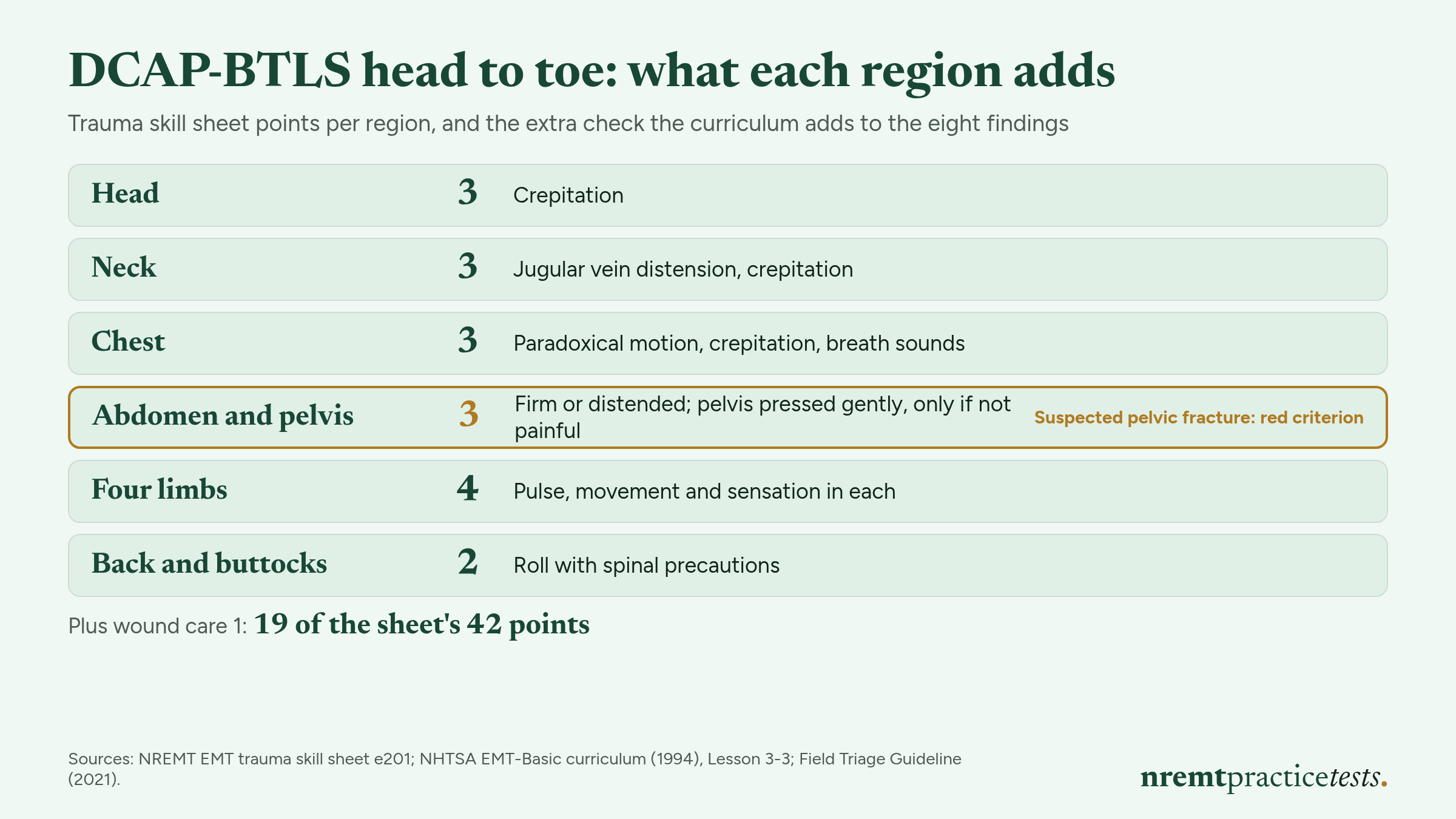
The sheet marks parts of the head (scalp and ears, mouth and nose), the neck, chest, abdomen and pelvis, legs and back with two asterisks: they may be checked during the primary survey. That is how a sucking chest wound gets found while you are still on breathing, not ten minutes later. Our medical and trauma assessment guide walks the rest of that sheet line by line, and the NREMT skills sheets guide covers the splinting and bleeding sheets that follow from what DCAP-BTLS finds.
How our practice exams test DCAP-BTLS
Our practice exams rarely ask what a letter stands for. They give you the finding and ask what to do with it. We tagged the 200 questions on our practice exams on November 25, 2026. Only one names DCAP-BTLS. In another 30, a DCAP-BTLS or TIC finding appears in the question or its choices and the correct answer deals with that injury:
| Finding in the question | Questions | What they ask |
|---|---|---|
| Burns | 8 | Size by the rule of nines, depth, cooling and dressing, chemical burns, airway burns |
| Punctures or penetrations | 8 | Impaled objects, open chest wounds and a sealed one that turns into a tension pneumothorax, stab wounds that bleed, evidence at a shooting |
| Lacerations | 4 | Bleeding control, an open abdominal wound, a neck wound, a focused exam |
| Deformities | 3 | Splinting and pulse, movement and sensation checks, hidden blood loss |
| Instability (TIC) | 3 | An unstable pelvis or a flail chest segment: shock, ventilation and the traction splint |
| Contusions | 2 | Bruises that do not match the story in a child, bruising behind the ear after a blow to the head |
| Tenderness | 1 | Midline neck tenderness and spinal motion restriction |
| Crepitus (TIC) | 1 | Crackling under the skin of the neck and chest: air leaking from the lung or airway |
| Abrasions, swelling | 0 | Neither is the main finding in a question |
Secondary assessment is only 5 to 9% of the EMT exam (EMT Examination Specifications), but these findings reach well beyond it. Of the 30, we file 12 under patient treatment and transport, 12 under primary assessment, 1 each under scene size-up and operations, and only 4 under secondary assessment, because these questions care about what you do once you find the injury. Learn the letters in a day. Spend the time on the care each finding triggers. Our NREMT study guide splits the study days by domain.
Three worked questions
All three are on our practice exams. Answer each before you read the explanation.
Drag-and-drop, from NREMT Exam Practice 9. A cyclist was struck by a car. During your head-to-toe assessment you use DCAP-BTLS. Sort each finding by the part of DCAP-BTLS it falls under: deformity, contusion, abrasion, puncture or penetration, or tenderness.
1. The left forearm bends at an angle midway between the wrist and the elbow
2. A purple-blue bruise across the right side of the ribs
3. Skin scraped away on both knees, with bits of gravel in it
4. A small, round hole in the thigh where a piece of the bike pierced the skin
5. Pain when you press on the right collarbone, though the skin there looks normal
6. A dark blue mark the size of a palm over the left hip
Answer: 1 deformity, 2 contusion, 3 abrasion, 4 puncture or penetration, 5 tenderness, 6 contusion. Number 5 is the one people miss: nothing shows, so it can only be tenderness, found by pressing. Number 6 is a second contusion. A bruise is a contusion wherever it is, and the bruise over the ribs also warns of a rib or lung injury beneath it.
Multiple choice, from NREMT Exam Practice 7. A motorcyclist was thrown from his bike. His right thigh is swollen and angulated midway between the hip and knee. You are considering a traction splint for that leg. Which additional finding means you should not use one?
A. He has severe pain whenever the leg is moved
B. The pelvis is tender and moves when you gently press on it
C. His left leg has no injury and moves normally
D. The pulse in his right foot is weaker than in his left
Answer: B. Tenderness and instability, the T and I of TIC, in the pelvis. A traction splint pushes against the pelvis, so a pelvic injury rules it out, and an unstable pelvis suggests major internal bleeding. A is expected with a femur fracture. D needs watching but does not rule the splint out. The thigh shows two more letters, swelling and deformity.
Multiple choice, from NREMT Exam Practice 5. A 30-year-old was thrown from a car that rolled over. He responds only to pain. You have managed his airway, breathing, and bleeding and decided on rapid transport. Which approach fits his secondary assessment?
A. A SAMPLE history and OPQRST from him before any further exam
B. A check of pulses, movement, and feeling in each arm and leg only
C. A head-to-toe exam of the whole body, looking and feeling for injuries
D. A focused exam of the most obvious injury, his deformed right leg
Answer: C. Ejection and a rollover are both significant mechanisms, and a patient who responds only to pain cannot tell you where he hurts. That is the rapid trauma assessment: DCAP-BTLS in every region, often done on the way. D is the trap. The deformed leg is obvious, and bleeding inside his abdomen would not be.
The opposite case is on Exam 6: a cut palm from slicing a bagel, no fall, an alert patient. There the right answer is a focused exam of the hand with circulation, movement and sensation. The mechanism decides how far DCAP-BTLS goes. Our methodology page explains how each question is written and checked, and the study guide lists the other topic guides.
Frequently asked questions
What does DCAP-BTLS stand for?
Deformities, contusions, abrasions, punctures or penetrations, burns, tenderness, lacerations and swelling. They are the eight signs of injury the 1994 EMT-Basic National Standard Curriculum tells an EMT to look and feel for in every body region during the trauma exam.
What is TIC in EMS?
TIC stands for tenderness, instability and crepitus. It is added to DCAP-BTLS as the things you feel for with your hands. Tenderness is already the T in DCAP-BTLS. Instability is a part that moves when it should not, such as a pelvis that gives under gentle pressure. Crepitus is a grating or crackling under your fingers.
When do you use DCAP-BTLS?
After the primary assessment, once threats to the airway, breathing and circulation are handled. A patient with a significant mechanism of injury or an altered mental status gets it in every region from head to toe. A patient with a minor, isolated injury, such as a cut finger, gets it at the injury site only.
Is DCAP-BTLS on the NREMT trauma skill sheet?
The word is not on it. The trauma sheet (e201) scores the regions instead: head, neck, chest, abdomen and pelvis 3 points each, each limb 1, the back and buttocks 2, and wound care 1, for 19 of its 42 points. DCAP-BTLS is the checklist you run in each of those regions.
What is the difference between a rapid trauma assessment and a focused exam?
A rapid trauma assessment is a quick head-to-toe exam for a patient who could be hurt anywhere: a significant mechanism, or a patient who cannot reliably tell you where it hurts. A focused exam looks only at the injured area, for a minor mechanism and an alert patient. Both use the same DCAP-BTLS findings.
Built and maintained by the NREMT Practice Tests team. Items are original and tagged to the published EMT exam domains before they go up. Each rationale is reviewed before publish. These are study questions, not official National Registry items and not medical advice. About this site →