EMT Airway Management, Step by Step
Last updated: November 11, 2026
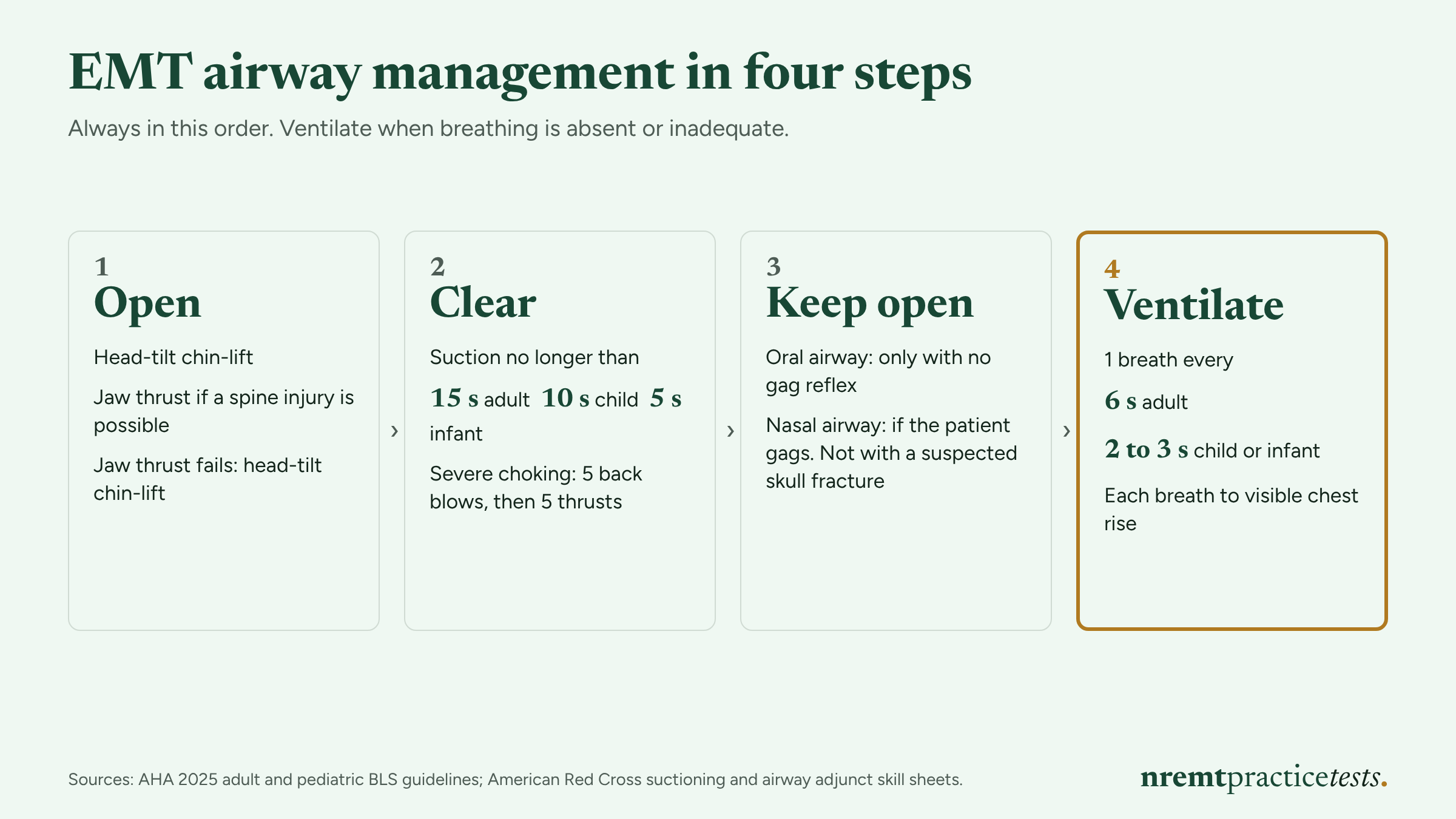
EMT airway management is four steps in a fixed order: open the airway, clear it, keep it open, and ventilate if breathing is absent or inadequate. For an adult with a pulse who is not breathing normally, that means 1 breath every 6 seconds with a bag-valve mask, each breath just enough to make the chest rise (AHA 2025 adult basic life support).
Every step has a number or a rule the exam likes to test, and most of them change with age. This guide takes each step from its primary source, puts the numbers for adults, children and infants in one table, and works three questions from our free NREMT practice tests. The common thread is simple: oxygen is not an airway, and it is not ventilation.
Where airway questions sit on the EMT exam
The current EMT exam has no airway domain. Since April 7, 2025, the National Registry has used five domains that follow the order of a call, and airway is split across two of them. Primary assessment, 39 to 43% of the exam, lists “assess patient’s airway” and “assess patient’s breathing status”, and patient treatment and transport, 20 to 24%, lists “manage patient’s airway, ventilation, and oxygenation” (EMT Examination Specifications, PDF).
“Airway, Respiration and Ventilation” is now a domain name only on the AEMT and paramedic exams (National Registry examination content). Quizzes built under that heading still cover useful material, but they are sorted by the old outline. Our NREMT study guide explains the change and turns the new weights into a 4-week plan.
Step 1: Open the airway
In an unresponsive patient, the usual blockage is the tongue falling back against the throat. Snoring is the sound it makes.
- No suspected spine injury: head-tilt chin-lift, for adults, children and infants alike.
- Possible spine injury: jaw thrust without tilting the head.
- Jaw thrust fails: if a jaw thrust and an airway adjunct still do not open the airway, use a head-tilt chin-lift. A patient you cannot ventilate will not survive to have the spine protected.
The 2025 guidelines recommend all three, for adults (AHA 2025 adult basic life support) and for infants and children (AHA/AAP 2025 pediatric basic life support).
The spine never outranks the airway. Expect a question where the jaw thrust has failed and one choice says to keep it anyway to protect the neck. That choice is wrong. Our medical and trauma assessment guide works that exact item from Exam 6.
Step 2: Clear the airway
Suction
Gurgling means liquid in the airway. Suction it before you ventilate, or each breath pushes blood and vomit into the lungs.
- Check the unit first: turn it on and confirm it pulls at the tip.
- Insert a rigid tip only as far as you can see, with no suction applied (the National Registry skill sheet scores this step).
- Suction on the way out, for no more than 15 seconds in an adult, 10 in a child and 5 in an infant (American Red Cross suctioning skill sheet, PDF).
- Then ventilate. Suction removes air along with the fluid.
The National Registry’s skill sheet for ventilating an apneic adult fails a candidate who suctions “for an excessive and prolonged time” or who does not start ventilating within 30 seconds after suctioning (BVM Ventilation of an Apneic Adult Patient, PDF).
Choking: the 2025 change
A patient who can cough forcefully and speak has a mild obstruction. Let them cough and watch closely. A patient who cannot speak, cough or breathe has a severe one, and the 2025 AHA guidelines changed what you do first.
- Adults and children: repeated cycles of 5 back blows, then 5 abdominal thrusts, until the object comes out or the patient becomes unresponsive. A study of 709 choking patients in Alberta found back blows linked to better relief and fewer injuries than abdominal thrusts (Resuscitation, 2024).
- Late pregnancy, or you cannot reach around the abdomen: 5 back blows, then 5 chest thrusts.
- Infants: 5 back blows alternating with 5 chest thrusts, now given with the heel of one hand. Never abdominal thrusts.
- Unresponsive: start CPR with compressions. Each time you open the airway for breaths, look in the mouth and remove an object only if you can see it.
- Never a blind finger sweep. The 2025 AHA guidelines advise against it at every age, because it can push the object deeper.
Multiple choice, from NREMT Exam Practice 2. A conscious adult is choking and cannot speak or cough. What do you do?
A. Encourage a cough, and give oxygen while you watch
B. Give abdominal thrusts first, and add back blows only if the thrusts fail
C. Give back blows, then abdominal thrusts, and keep alternating until the object is out or the patient becomes unresponsive
D. If the patient becomes unresponsive, start CPR and remove the object only if you can see it
Answer: C. This is the 2025 sequence for a severe obstruction in a conscious adult. A is right only while the patient can still cough and speak, and oxygen does not move an object. B is the old habit, with the order reversed. D is correct care, but for a later moment: this patient is still conscious.
Step 3: Keep the airway open
Once the airway is open and clear, an adjunct holds the tongue off the back of the throat so you can keep ventilating. Placed wrong, an oral airway can push the tongue back and make the blockage worse. The details below follow the American Red Cross airway adjuncts skill sheet (PDF).
| Oral airway (OPA) | Nasal airway (NPA) | |
|---|---|---|
| Who gets it | Unresponsive, with no gag reflex | Responsive or unresponsive. It does not trigger the gag |
| Do not use | Any gag, oral trauma such as broken teeth, recent mouth surgery | Suspected skull fracture or head injury |
| Size | Corner of the mouth to the earlobe (many texts use the angle of the jaw) | Tip of the nostril to the earlobe, no wider than the nostril |
| Insert | Adult: tip toward the roof of the mouth, turn it 180 degrees as it reaches the back. Child or infant: a tongue blade holds the tongue and the airway goes in the way it will sit, or it goes in sideways and turns 90 degrees | Water-soluble lubricant, bevel toward the septum, straight back along the floor of the nose. Never force it. Try the other nostril |
| Placed right | Flange rests on the lips | Flange rests on the nostril |
If the patient gags on an oral airway, take it out. A bigger one or a different insertion trick does not fix a gag reflex.
Multiple choice, from NREMT Exam Practice 6. An adult has just stopped having a seizure. He is unresponsive and snoring, his jaw is clenched, and he gags when you try to open his mouth. He has no head or facial injury. A head-tilt, chin-lift helps but does not stop the snoring. Which airway adjunct do you use?
A. A nasal airway, lubricated and sized nose to earlobe
B. An oral airway inserted with a tongue blade
C. An oral airway inserted upside down and rotated
D. No adjunct, while you keep suctioning his mouth
Answer: A. He gags and his jaw is clenched, which rules out any oral airway however it goes in (B and C). He has no head or facial injury, so a nasal airway is safe. D treats fluid, but snoring is the tongue, not fluid.
Step 4: Ventilate, or just give oxygen?
This is the decision our practice questions test most. Oxygen by nonrebreather mask helps a patient who is moving enough air on their own. It does nothing for one who is not. The National Registry’s oxygen skill sheet sets a nonrebreather at a flow of at least 10 L/min with the reservoir prefilled (Oxygen Administration by Non-Rebreather Mask, PDF).
When breathing is absent or inadequate, the patient needs your breaths: too slow, too shallow, a falling level of responsiveness. The AHA notes that a person with a pulse can reach dangerously low oxygen levels after only 90 seconds without breathing.
- Adult with a pulse: 1 breath every 6 seconds, 10 a minute, each one making the chest rise (AHA 2025).
- Child or infant with a pulse: 1 breath every 2 to 3 seconds, 20 to 30 a minute (AHA/AAP 2025).
- Each breath: just to visible chest rise. Big or fast breaths fill the stomach and invite vomiting.
- Oxygen: connect the bag to oxygen at 15 L/min. The skill sheet fails a candidate who does not provide at least 85% oxygen.
- Poor seal: bag-mask ventilation works best with two rescuers, one sealing the mask with both hands while the other squeezes the bag (AHA 2025).
Two rates, one answer. The National Registry's 2016 bag-valve-mask skill sheet scores 10 to 12 breaths a minute, 1 every 5 to 6 seconds. The 2025 AHA guideline says 1 every 6 seconds. Ventilate an adult at 1 breath every 6 seconds and you meet both.
Multiple choice, from NREMT Exam Practice 7. A 67-year-old man with COPD has been struggling to breathe for two days. When you arrived he was sitting upright, breathing 34 times a minute and answering in short phrases. You placed him on oxygen. Ten minutes later his respiratory rate is 10, his breaths are shallow, his head keeps dropping forward, and he opens his eyes only when you speak loudly. What do you do now?
A. Lay him flat and raise his legs to improve blood flow to his brain
B. Continue the oxygen, since his breathing rate has come back down into a safe range
C. Reduce the oxygen flow, because the oxygen is the reason his breathing slowed
D. Begin assisting his breathing with a bag-valve mask and supplemental oxygen
Answer: D. A rate that falls from 34 to 10 while he gets drowsy is not recovery. He is tiring out and heading into respiratory failure, so he needs ventilation, not just oxygen. B mistakes the number for improvement. C turns the oxygen down, which does not ventilate him, and he still needs oxygen. A makes breathing harder, and his problem is ventilation, not blood flow.
The numbers by age
| Adult | Child (1 year to puberty) | Infant (under 1 year) | |
|---|---|---|---|
| Open the airway | Head-tilt chin-lift. Jaw thrust if a spine injury is possible, head-tilt chin-lift if the jaw thrust fails | ||
| Longest suction | 15 seconds | 10 seconds | 5 seconds |
| Ventilation rate, with a pulse | 1 every 6 seconds (10 a minute) | 1 every 2 to 3 seconds (20 to 30 a minute) | 1 every 2 to 3 seconds (20 to 30 a minute) |
| Severe choking, responsive | 5 back blows, then 5 abdominal thrusts, repeat | 5 back blows, then 5 abdominal thrusts, repeat | 5 back blows, then 5 chest thrusts, repeat |
| Choking, unresponsive | CPR starting with compressions. Look in the mouth before breaths, remove only what you can see | ||
Sources: AHA 2025 adult and pediatric basic life support guidelines; American Red Cross suctioning skill sheet. All of them are listed on our sources page.
How our practice questions test the airway
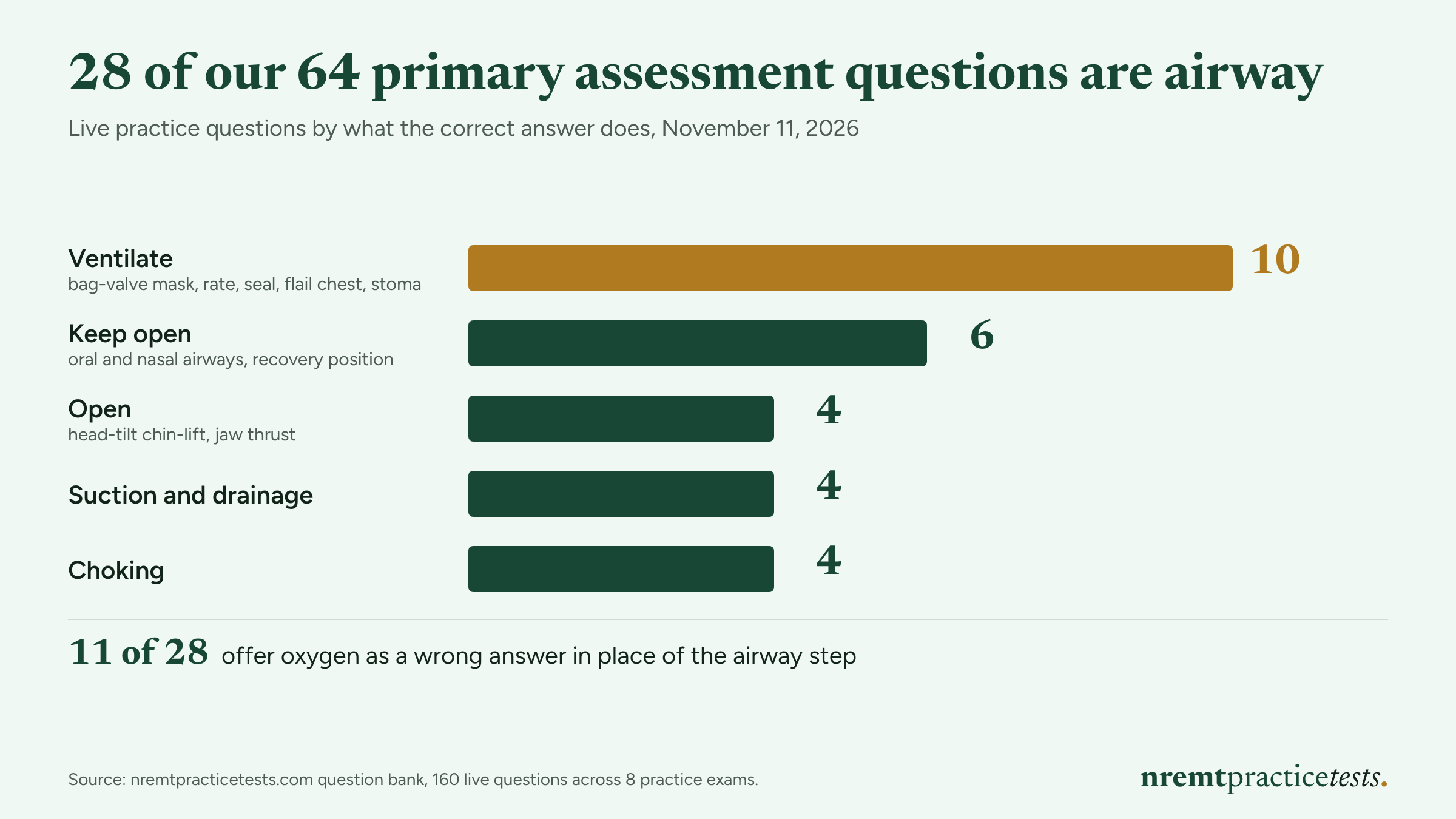
We sorted our 64 live primary assessment questions by what the correct answer does, on November 11, 2026. In 28 of them (44%), the answer opens, clears, keeps open or ventilates the airway. That is the largest single block in our largest section. Ventilation leads with 10, then adjuncts and positioning with 6, and opening, suction and choking with 4 each.
The pattern in the wrong answers is just as useful. In 11 of the 28, one wrong choice offers oxygen instead of the airway step: a nonrebreather for a snoring patient, for a gurgling one, for a man breathing 4 times a minute through a stoma. Oxygen is never the right answer to an airway that is closed, full or not moving air. When you see it next to “open”, “suction” or “ventilate”, it is there to catch you.
All 28 are in the EMT primary assessment practice questions, together with every other primary assessment item, each with a reason under every choice. Primary assessment can run from about 27 to 52 questions on the real exam, depending on its length; the passing score guide shows the arithmetic. For the rest of the topic guides, start at the NREMT study guide hub.
Frequently asked questions
What are the steps of EMT airway management?
Open the airway, clear it, keep it open, then ventilate if breathing is absent or inadequate. Open with a head-tilt chin-lift, or a jaw thrust when a spine injury is possible. Clear liquid with suction and a choking object with back blows and thrusts. Keep it open with an oral or nasal airway, and ventilate with a bag-valve mask and oxygen.
How long can an EMT suction a patient?
No more than 15 seconds at a time for an adult, 10 seconds for a child and 5 seconds for an infant, per the American Red Cross suctioning skill sheet. Suction removes air as well as fluid. The National Registry's bag-valve-mask skill sheet fails a candidate who suctions for an excessive time or does not start ventilating within 30 seconds after suctioning.
When do you use a nasal airway instead of an oral airway?
When the patient still has a gag reflex or a clenched jaw. An oral airway is only for an unresponsive patient with no gag reflex. A nasal airway does not trigger the gag, but it is not used when you suspect a skull fracture or serious head or facial injury.
How fast do you ventilate with a bag-valve mask?
For an adult with a pulse, 1 breath every 6 seconds, which is 10 a minute (AHA 2025). The National Registry skill sheet accepts 10 to 12 a minute, so 1 every 6 seconds meets both. For a child or infant with a pulse, 1 breath every 2 to 3 seconds, 20 to 30 a minute. Give each breath just until the chest rises.
Did the choking steps change in 2025?
Yes. The 2025 AHA guidelines tell rescuers to give a conscious adult or child with a severe obstruction 5 back blows, then 5 abdominal thrusts, and keep repeating until the object comes out or the patient becomes unresponsive. Infants get back blows and chest thrusts, never abdominal thrusts. Study material that starts with abdominal thrusts alone is out of date.
Built and maintained by the NREMT Practice Tests team. Items are original and tagged to the published EMT exam domains before they go up. Each rationale is reviewed before publish. These are study questions, not official National Registry items and not medical advice. About this site →