NREMT Passing Score: How the EMT Exam Decides Pass or Fail
Last updated: November 7, 2026
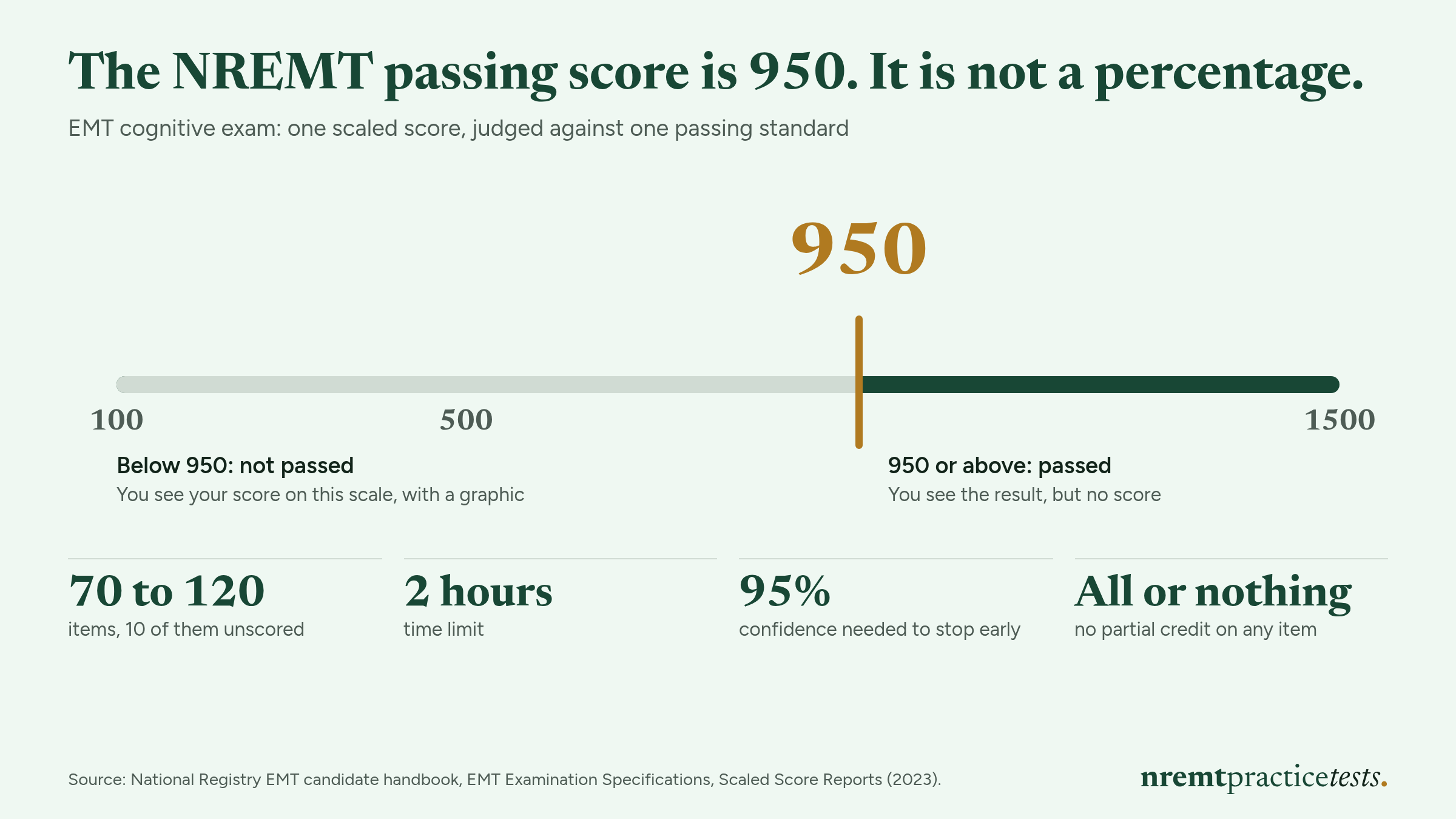
The NREMT passing score is 950 on a scale from 100 to 1500. It is a scaled score, not a percentage of questions answered correctly, and the same passing standard applies to every candidate (EMT candidate handbook). If you pass, you never see a number. If you do not, your score is posted on that scale.
This guide covers why there is no percentage to aim for, what your result does and does not tell you, how many questions each domain is likely to take up, and what happens after a failed attempt. It ends with how to read a score from our free NREMT practice tests without fooling yourself.
Why is there no passing percentage?
The EMT exam is a computerized adaptive test. After an opening set of items, the computer picks items at or above its current estimate of your ability (EMT Examination Specifications). Answer well and the questions get harder. Answer poorly and they stay around your level.
That design breaks the link between percent correct and the result. A strong candidate sees harder items and may miss plenty of them. The computer is not counting right answers. It is asking one question: is this candidate above or below the passing standard?
- Stop rule: the exam ends once the computer can make the pass or fail call with 95% confidence. If it cannot, it keeps going until 120 items or the 2-hour limit.
- Length: at least 70 items, at most 120.
- Pilot items: 10 of them are unscored. They look like every other item, so treat each one as if it counts.
The passing standard itself comes from a standard-setting study. A psychometrician leads a panel of EMS subject matter experts, the panel recommends a cut score, and the National Registry Board of Directors approves it. It is then applied the same way to all candidates and reviewed whenever a new test plan starts. The current EMT test plan went live on April 7, 2025, and the Registry said it did not expect any change in difficulty (EMR and EMT certification examinations).
950 out of 1500 is not 63%. The scale starts at 100, and a scaled score is not a count of correct answers. The Registry says the score is statistically adjusted for differences in difficulty between versions of the test (National Registry, 2023). No raw percentage maps to it.
What does your NREMT result show?
Results usually post to your National Registry account within two business days. If they have not posted after five business days, the handbook says to contact the Registry.
| Result | What you see |
|---|---|
| Passed | The result. No score and no details. |
| Not passed | Your score as a number on the 100 to 1500 scale, plus a graphic comparing it to the 950 passing point. |
Some prep pages still describe a failing report that rates each domain as above, near or below passing. That report is gone. The National Registry ran it beside the new scaled score from June 1, 2023 and removed it on September 1, 2023 (Scaled Score Reports, PDF).
The reason it gave matters for how you study. An adaptive test is built to be precise about the total in as few items as possible. In the Registry’s words, domain-level scores “are computed on too few items to allow for reliable score reporting,” so candidates who relied on them were studying from unreliable feedback.
Your own practice results are the only domain map you get. The real exam tells you pass or fail, and on a fail one overall number. Where your weak spots are is something you have to find yourself, before test day.
How many questions come from each domain?
The test plan gives each domain a share of the exam. The Registry does not publish item counts per sitting, but the weights let you estimate them. The table multiplies each range by the 70-item minimum and the 120-item maximum and rounds to whole items. Treat it as a rough guide: the 10 unscored items are inside those totals.
| Domain | Share of exam | At 70 items | At 120 items |
|---|---|---|---|
| Scene size-up and safety | 15 to 19% | about 11 to 13 | about 18 to 23 |
| Primary assessment | 39 to 43% | about 27 to 30 | about 47 to 52 |
| Secondary assessment | 5 to 9% | about 4 to 6 | about 6 to 11 |
| Patient treatment and transport | 20 to 24% | about 14 to 17 | about 24 to 29 |
| Operations | 10 to 14% | about 7 to 10 | about 12 to 17 |
Primary assessment alone is more questions than secondary assessment and operations put together. That is why our 4-week NREMT study plan spends its first week there, and why the primary assessment practice set is the best single place to spend extra time.
Every item is all or nothing
The Registry scores every item dichotomously: full credit for a fully correct response, none for a partly correct one. That rule hits hardest on the technology-enhanced items. A build list with two steps swapped scores the same as a blank.
Build list, from NREMT Exam Practice 7. You are called to a 58-year-old woman who feels weak and dizzy. The scene is safe and you have put on gloves. Arrange the steps of your primary assessment in order. One step does not belong in the primary assessment.
A. Make sure her airway is open
B. Decide on her priority for transport
C. Obtain a SAMPLE history
D. Assess the rate and quality of her breathing
E. Check her pulse, skin, and for any major bleeding
F. Form a general impression as you walk up to her
G. Check her level of responsiveness using AVPU
Answer: F, G, A, D, E, B. C does not belong. The general impression forms as you approach, then responsiveness, then airway, breathing and circulation, and the transport decision closes the primary assessment. The SAMPLE history belongs to the secondary assessment. Leave it in the list anywhere, or swap breathing and circulation, and the whole item scores zero.
The order here is the same one the National Registry’s skill sheets score, which the medical and trauma assessment guide walks through step by step.
What happens if you do not pass?
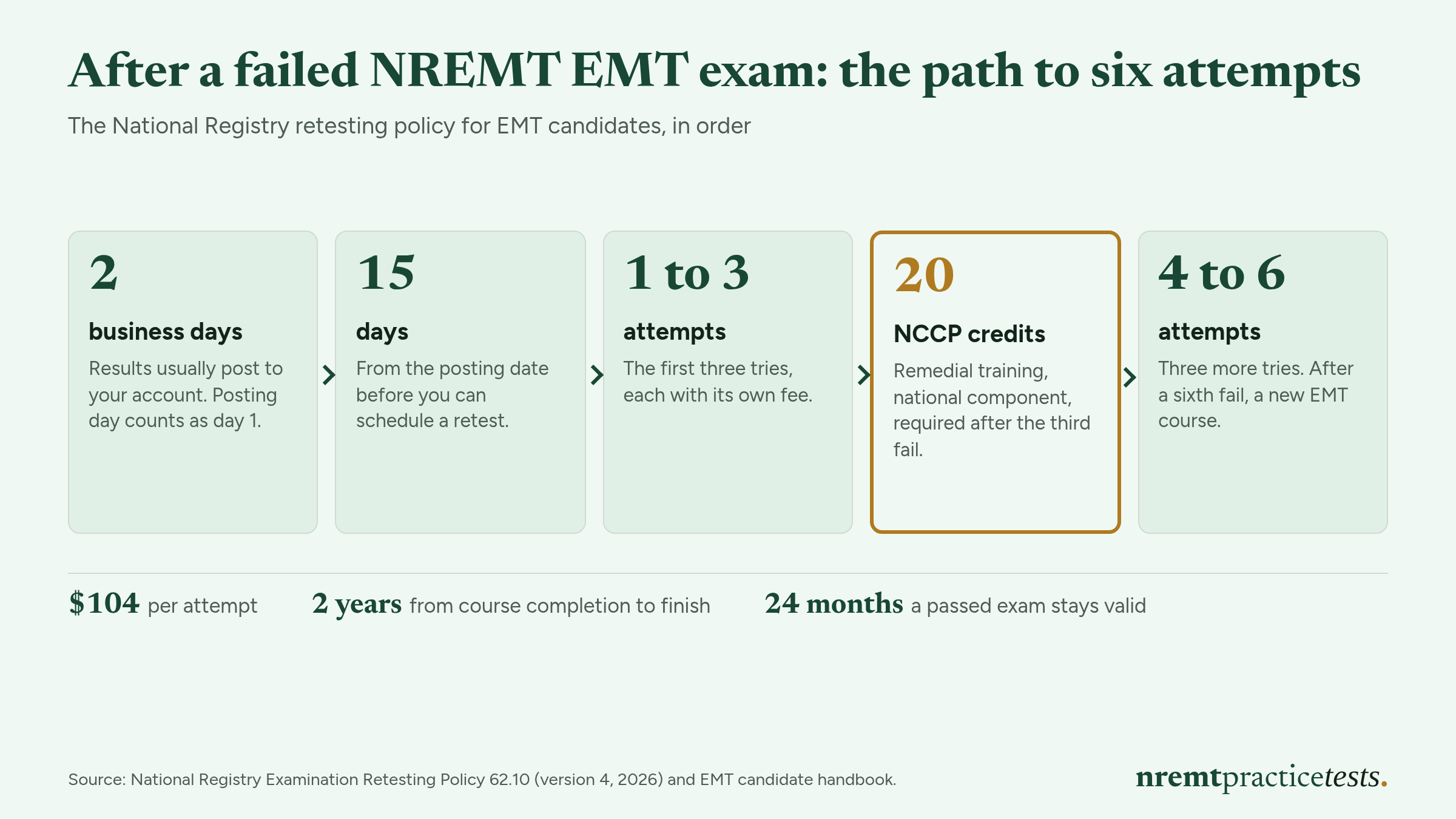
EMT candidates get six attempts in total under the Registry’s retesting policy (Examination Retesting Policy 62.10, version 4, PDF).
- Wait 15 days. You can apply to retest once your results post. The 15-day wait before you can schedule starts on the day your results post, which the policy counts as day 1. The handbook’s shorter wording counts 15 days from your last exam date, so plan from the later of the two.
- Attempts 1 to 3. Every attempt, including attempts 4 to 6, costs the $104 application fee (EMT certification process).
- Remedial training after the third fail. The policy names the 20-credit national component of the National Continued Competency Program. The EMT handbook also accepts a state or CAPCE-approved EMT refresher course, and some states accept only the refresher, so check with your State EMS Office. Completing it earns three more attempts.
- After a sixth fail, you need a new education program that meets the eligibility rules.
Watch the calendar as well as the count. An initial EMT course is valid for two years from the month and year you completed it, and remedial training for a fourth attempt does not extend that date. Your state also has its own skills requirement, which the Registry tracks separately.
What can a practice test score tell you?
Our free NREMT practice tests are seven fixed 20-item exams, 140 original questions in all. Fixed forms are scored the plain way: right answers out of 20. That number is not a scaled score, and it cannot be converted to one. No practice percentage, ours or anyone else’s, maps to 950.
What a fixed form can do is mirror the exam’s balance, so your misses point somewhere useful. Here is how our 140 live questions split, counted on November 7, 2026:
| Domain | Official share | Our 140 questions | Per 20-item exam |
|---|---|---|---|
| Scene size-up and safety | 15 to 19% | 23 (16%) | 3 or 4 |
| Primary assessment | 39 to 43% | 56 (40%) | 8 |
| Secondary assessment | 5 to 9% | 14 (10%) | 2 |
| Patient treatment and transport | 20 to 24% | 28 (20%) | 4 |
| Operations | 10 to 14% | 19 (14%) | 2 or 3 |
Secondary assessment runs one point over its range, because 20 items cannot land inside all five ranges at once. Of the 140, 106 are multiple choice and 34 use the technology-enhanced formats (multiple response, build list, drag-and-drop and options table), all scored all or nothing like the real exam. How we write and check each item is on the methodology page, and the outline facts above are listed on our sources page.
Use the results for what they can show:
- Read domains across several exams, not one. Two primary assessment misses on one exam is noise. The same domain low on three exams is a pattern.
- Take the timed mode seriously. One minute per item is the pace the real exam allows at its maximum length.
- Review every reason, including on items you got right. A lucky guess on a build list will not repeat on test day.
For the full topic list, start at the NREMT study guide hub.
Frequently asked questions
What is the passing score for the NREMT EMT exam?
950, on a scale that runs from 100 to 1500. The exam is scored as a whole, and the same passing standard applies to every candidate. If you pass, the National Registry does not send you a score. If you do not pass, your score is posted to your account on that scale.
What percentage do you need to pass the NREMT?
There is no percentage. The exam is adaptive: after an opening set, the questions are aimed at or above your estimated ability, so the share you get right does not decide the result. Dividing 950 by 1500 gives 63%, but that number means nothing, because 950 is a scaled score and not a count of correct answers.
Does the NREMT tell you your score if you pass?
No. A passing candidate gets the result without score details. Only candidates who do not pass see a number, shown on the 100 to 1500 scale together with a graphic that compares it to the 950 passing point.
How many times can you take the NREMT EMT exam?
Six times. You can schedule a retest after a 15-day wait that starts on the day your results post (the posting day counts as day 1). After three failed attempts you must complete remedial training before you get three more: the 20-credit national component of the National Continued Competency Program, or a state or CAPCE-approved EMT refresher course. After six, you need a new EMT course.
If my exam stopped at 70 questions, did I pass?
Not necessarily. The exam stops at 70 items whenever the computer is 95% confident of either result, so a short exam can be a clear pass or a clear fail. A candidate can pass at 120 items too.
Built and maintained by the NREMT Practice Tests team. Items are original and tagged to the published EMT exam domains before they go up. Each rationale is reviewed before publish. These are study questions, not official National Registry items and not medical advice. About this site →