The NREMT Medical Assessment and Trauma Assessment, Step by Step
Last updated: October 31, 2026
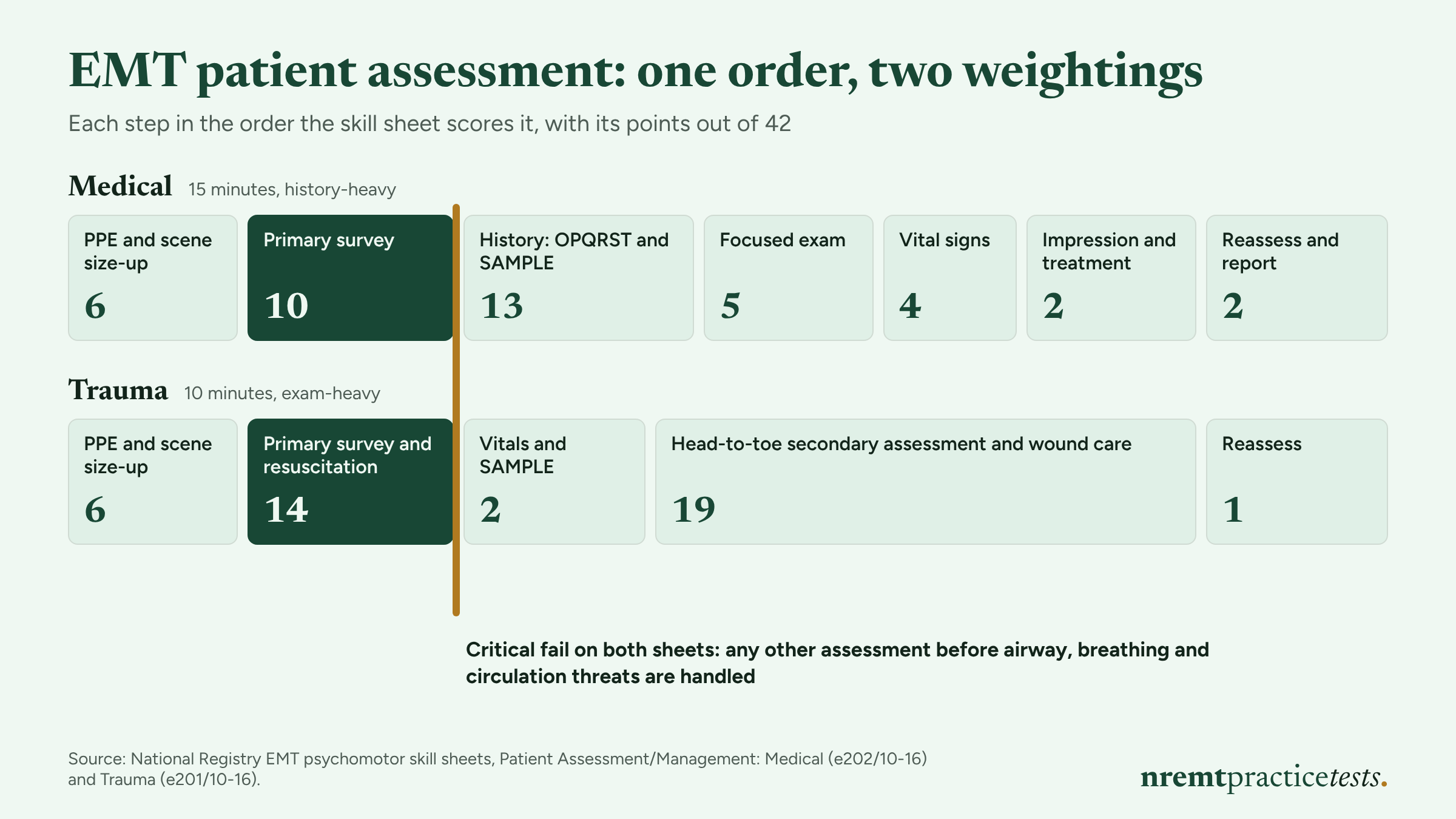
The NREMT medical assessment and trauma assessment run in the same order: PPE and scene size-up, primary survey, history taking, secondary assessment, then reassessment. Each EMT skill sheet is worth 42 points; the medical call has 15 minutes and the trauma call 10. What changes is the weight. History is 13 points on the medical sheet and 2 on the trauma sheet, while the head-to-toe exam is 19 points on the trauma sheet (Medical, PDF; Trauma, PDF).
This guide walks both sheets step by step, compares their critical fails, and shows how the written exam asks about the same steps, with counts from our own practice questions and three of them worked through.
Which skill sheets are the EMT ones?
The EMT sheets are titled Patient Assessment/Management: Medical (form e202/10-16) and Trauma (e201/10-16), under “Emergency Medical Technician Psychomotor Examination”. Search results for these terms also turn up sheets P301 and P302. Those are headed “Advanced Level Psychomotor Examination”, and they differ: the advanced medical sheet totals 48 points and adds 2 for diagnostics, including an ECG monitor for chest pain and dyspnea (P302, PDF). An EMT does not need them.
The Registry’s own FAQ asks why there is still a psychomotor exam for BLS but not for ALS. It answers that the EMR and EMT psychomotor process is established and approved by each state (EMR and EMT certification examinations). Check your state’s process. The E sheets still show the order in which the Registry scores an EMT patient assessment.
The two sheets side by side
| Step | Medical (e202) | Trauma (e201) |
|---|---|---|
| PPE precautions | 1 | 1 |
| Scene size-up: safety, mechanism or nature of illness, number of patients, more help, spine | 5 | 5 |
| Primary survey | 10 | 14 |
| History taking | 13: OPQRST 6, clarifying questions 2, past medical history 5 | 2: baseline vitals 1, SAMPLE 1 |
| Secondary assessment | 5: the affected body system | 19: head, neck, chest, abdomen and pelvis, all four limbs, back, then wounds |
| Vital signs | 4: blood pressure, pulse, respiratory rate and quality | Counted in history taking |
| Field impression and interventions | 2 | Not scored as lines |
| Reassessment | 1 | 1 |
| Verbal report to arriving EMS unit | 1 | Not on the sheet |
| Total, time limit | 42, 15 minutes | 42, 10 minutes |
The pattern is easy to remember. A medical patient usually tells you what is wrong, so the medical sheet pays for questions. An injured patient may not know or may not be able to say, so the trauma sheet pays for hands.
Step 1: PPE and scene size-up (6 points on both)
The first six lines are word for word the same on both sheets: PPE precautions, scene safety, the mechanism of injury or nature of illness, the number of patients, a call for more EMS help if needed, and considering spinal stabilization. Two of them are also critical fails: missing PPE and missing scene safety. With more than one patient, the size-up turns into triage.
Step 2: the primary survey (10 or 14 points)
Both sheets open the primary survey the same way: a general impression, responsiveness or level of consciousness (the medical sheet names AVPU), and the chief complaint and apparent life threats. Then airway, breathing and circulation, and a priority and transport decision.
The trauma version is worth 4 more points because it asks for more hands-on work:
- Airway, 2 points: open and assess it, and insert an adjunct as indicated.
- Breathing, 4 points: assess breathing, assure adequate ventilation, start oxygen, and manage any injury that compromises breathing.
- Circulation, 4 points: check the pulse, assess the skin, control major bleeding, and start shock management (position the patient, conserve body heat).
- Priority: the transport decision is based on a calculated GCS.
The medical version scores airway and breathing together (assessment, ventilation, oxygen) and circulation as bleeding, pulse and skin, 3 points each.
Nothing else comes before this step is handled. The medical sheet fails a candidate who "performs secondary examination before assessing and treating threats to airway, breathing and circulation". The trauma sheet says "performs other assessment" in the same place. On both, failing to find or manage problems with the airway, breathing, hemorrhage or shock is its own critical fail.
Step 3: history taking
On the medical sheet this is the biggest section. Each OPQRST letter (onset, provocation, quality, radiation, severity, time) is 1 point, clarifying questions about associated signs and symptoms add 2, and allergies, medications, past pertinent history, last oral intake and events leading to the illness are 1 each. Our SAMPLE and OPQRST guide gives the question behind each letter.
On the trauma sheet, history taking is two lines: baseline vital signs, which must include blood pressure, pulse and respirations, and an attempt at a SAMPLE history.
Step 4: the secondary assessment
Medical, 5 points. You assess the affected body part or system: cardiovascular, pulmonary, neurological, musculoskeletal, integumentary, GI/GU, reproductive, or psychological and social. Chest pain gets a cardiovascular and pulmonary exam, not a check of the knee. Vital signs follow, 4 points.
Trauma, 19 points. A full head-to-toe exam: head 3, neck 3, chest 3, abdomen and pelvis 3, each leg 1, each arm 1, back and buttocks 2, then managing secondary injuries and wounds 1. Each limb is checked for motor, sensory and distal circulation. The sheet notes that the areas marked with two asterisks, which include the mouth, nose, neck, chest, abdomen and pelvis, legs and back, may be checked during the primary survey. That is how a fast candidate finds a chest wound while still on breathing.
Step 5: the end of the call
The medical sheet closes with a field impression, the interventions you would give, how and when to reassess, and a verbal report to the arriving EMS unit. Failing to give an accurate report is a critical fail on the medical sheet only. The trauma sheet ends with one line: how and when to reassess the patient.
Critical fails compared
| Critical criterion | Medical | Trauma |
|---|---|---|
| Transport started or called within the limit | 15 minutes | 10 minutes |
| PPE precautions, scene safety | Yes (safety "before approaching patient") | Yes |
| Oxygen | Appropriate oxygen therapy | High concentration oxygen |
| Adequate ventilation; airway, breathing, hemorrhage or shock problems | Yes | Yes |
| Immediate transport versus more care on scene | Yes | Yes |
| Other assessment before airway, breathing and circulation threats | Yes | Yes |
| Spinal protection when indicated | No | Yes |
| Accurate report to arriving EMS unit | Yes | No |
| Competent EMT, acceptable affect, no dangerous intervention | Yes | Yes |
How the written exam asks about the same steps
On the cognitive EMT exam, primary assessment is 39 to 43% of the test, the largest of the five domains (EMT Examination Specifications). Our NREMT study guide covers all five.
We sorted the 48 primary assessment questions on our first six practice exams by the step the correct answer acts on. Airway decides 18 of them: opening it, clearing it, choosing an adjunct, choking. Breathing and ventilation decide 13, cardiac arrest 7, and bleeding and perfusion 6.
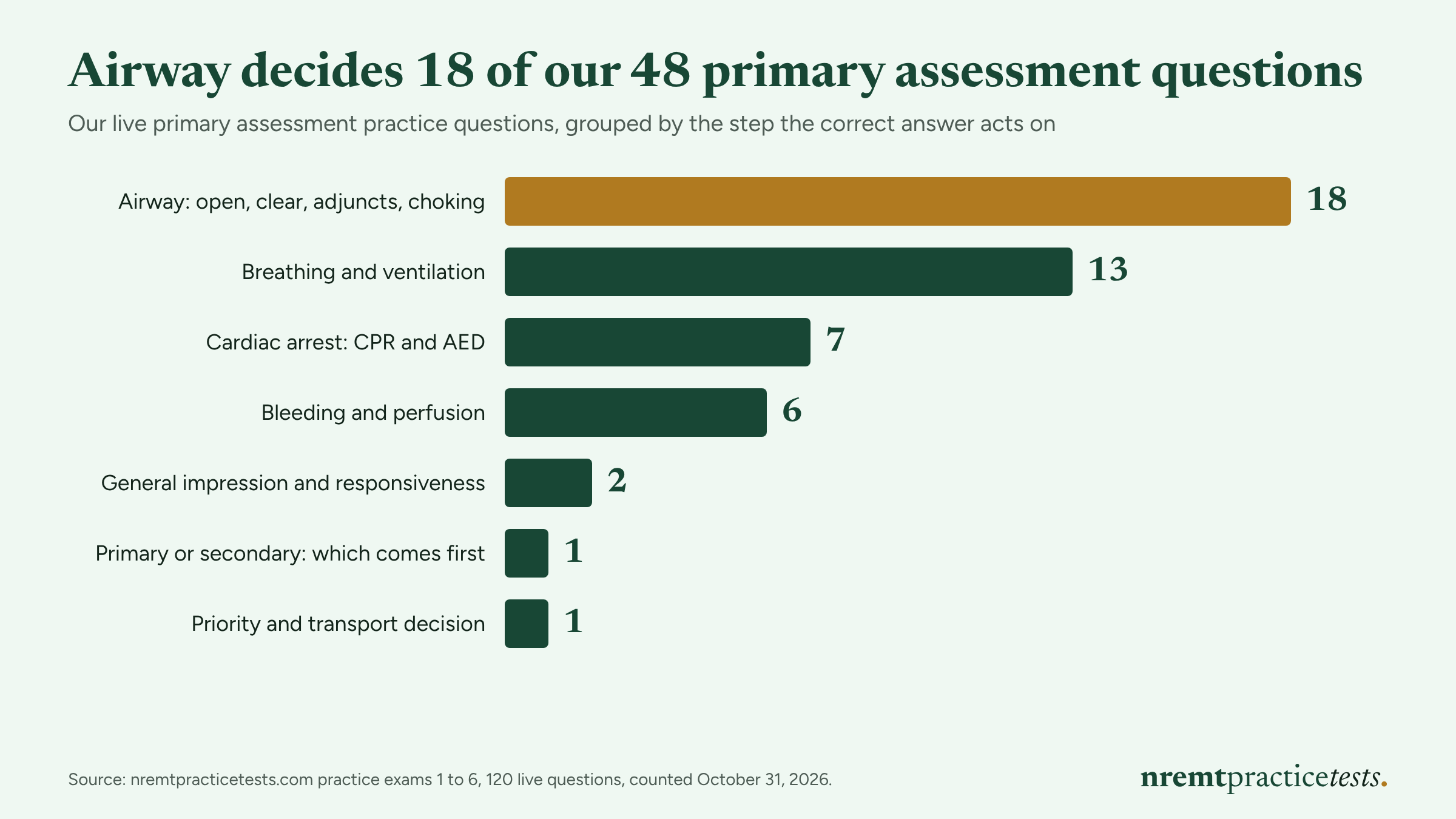
The written exam also tests the critical fail. In 15 of those 48 questions, one choice stops to take a SAMPLE history, a set of vital signs, a blood glucose, an APGAR score or a fuller exam (such as log-rolling to inspect the back) before the life threat is treated. None of those 15 choices is the correct answer. “Take a full set of vital signs, then suction” and “check a pulse and a blood pressure before you touch the chest again” are both in the set. When a choice puts assessment ahead of an open airway, ventilation, bleeding control or compressions, it is the same mistake that fails the skill station.
Three worked questions
All three are on our practice exams. Answer each before you read the explanation.
Multiple choice, from NREMT Exam Practice 4. You find an adult lying on a sidewalk with the eyes closed. The patient does not respond when you speak loudly, but groans and pulls the arm away when you pinch the muscle at the top of the shoulder. How do you record the mental status on the AVPU scale?
A. Responds to painful stimulus
B. Unresponsive
C. Alert
D. Responds to verbal stimulus
Answer: A. AVPU is graded by the weakest stimulus that gets a response, and here only pain did. B is wrong because withdrawal is a response. D is wrong because a loud voice got nothing. This is the second line of the primary survey on both sheets.
Multiple choice, from NREMT Exam Practice 6. A motorcyclist was thrown over the handlebars and is unresponsive with a pulse. Your partner holds his head in line. An oral airway is in place, the mouth is clear, and you have a good mask seal, but with a jaw-thrust maneuver you still cannot make the chest rise with the bag-valve mask. What do you do next?
A. Open the airway with a head-tilt chin-lift maneuver and ventilate again
B. Squeeze the bag harder and faster until you see the chest rise
C. Roll him onto his side so the airway can drain and open
D. Keep the jaw thrust, since protecting the spine comes before ventilation
Answer: A. The jaw thrust is the first choice when a spinal injury is possible, but an open airway comes first. Tilt only as far as it takes to make the chest rise. B pushes air into the stomach. C gives up the inline hold without opening the airway. D is the trap: the trauma sheet scores spinal protection, but a patient who cannot be ventilated dies of hypoxia whatever the spine shows.
Multiple response, from NREMT Exam Practice 4. After the primary assessment, which patients should be treated as high priority for rapid transport? Select every patient that applies.
A. A patient who opens their eyes to your voice but cannot follow simple commands
B. An adult with low back pain after lifting a box, normal vital signs, and normal leg strength
C. An adult with chest pain and a systolic blood pressure of 88 mm Hg
D. An adult with a deformed wrist who rates the pain 3 out of 10, with a strong radial pulse and warm, pink skin
E. A patient whose scalp wound keeps bleeding through firm direct pressure
Answer: A, C and E. Responding without following commands is an altered mental status. Chest pain with a systolic pressure under 100 suggests poor perfusion. Bleeding that direct pressure will not stop is uncontrolled. B and D have no sign of a threat to life. This is the last line of the primary survey, the priority and transport decision.
All of our primary assessment questions, from every practice exam, are in one set on the EMT primary assessment practice questions page. They are also spread through all seven practice exams, eight to an exam, starting with Exam 1. Our methodology explains how each question is written and checked, and the study guide lists the other topic guides.
Frequently asked questions
What is the order of the NREMT medical assessment?
PPE, scene size-up, primary survey, history taking (OPQRST and SAMPLE), a focused exam of the affected body system, vital signs, field impression, interventions, reassessment and a verbal report. The EMT medical skill sheet is worth 42 points and has a 15-minute limit.
How long do you have for the NREMT trauma assessment?
The EMT trauma skill sheet fails a candidate who does not initiate or call for transport within 10 minutes. The medical sheet allows 15. Both sheets are worth 42 points.
What is the difference between the medical and the trauma assessment?
The order is the same, but the weight moves. On the medical sheet history taking is the biggest section at 13 points and the exam is 5. On the trauma sheet history is 2 points and the head-to-toe secondary assessment with wound care is 19.
What are the critical fails on the NREMT patient assessment?
Both EMT sheets list failing to take PPE precautions, failing to determine scene safety, failing to manage problems with airway, breathing, hemorrhage or shock, and doing other assessment before treating threats to airway, breathing and circulation. Trauma adds spinal protection when indicated. Medical adds an accurate report to the arriving EMS unit.
What is included in the EMT primary assessment?
A general impression, level of consciousness, the chief complaint and apparent life threats, airway, breathing and circulation (pulse, skin and major bleeding), and a priority and transport decision. On the cognitive EMT exam, primary assessment is 39 to 43% of the test.
Built and maintained by the NREMT Practice Tests team. Items are original and tagged to the published EMT exam domains before they go up. Each rationale is reviewed before publish. These are study questions, not official National Registry items and not medical advice. About this site →