NREMT Skills Sheets: Every EMT Sheet and Its Critical Fails
Last updated: November 18, 2026
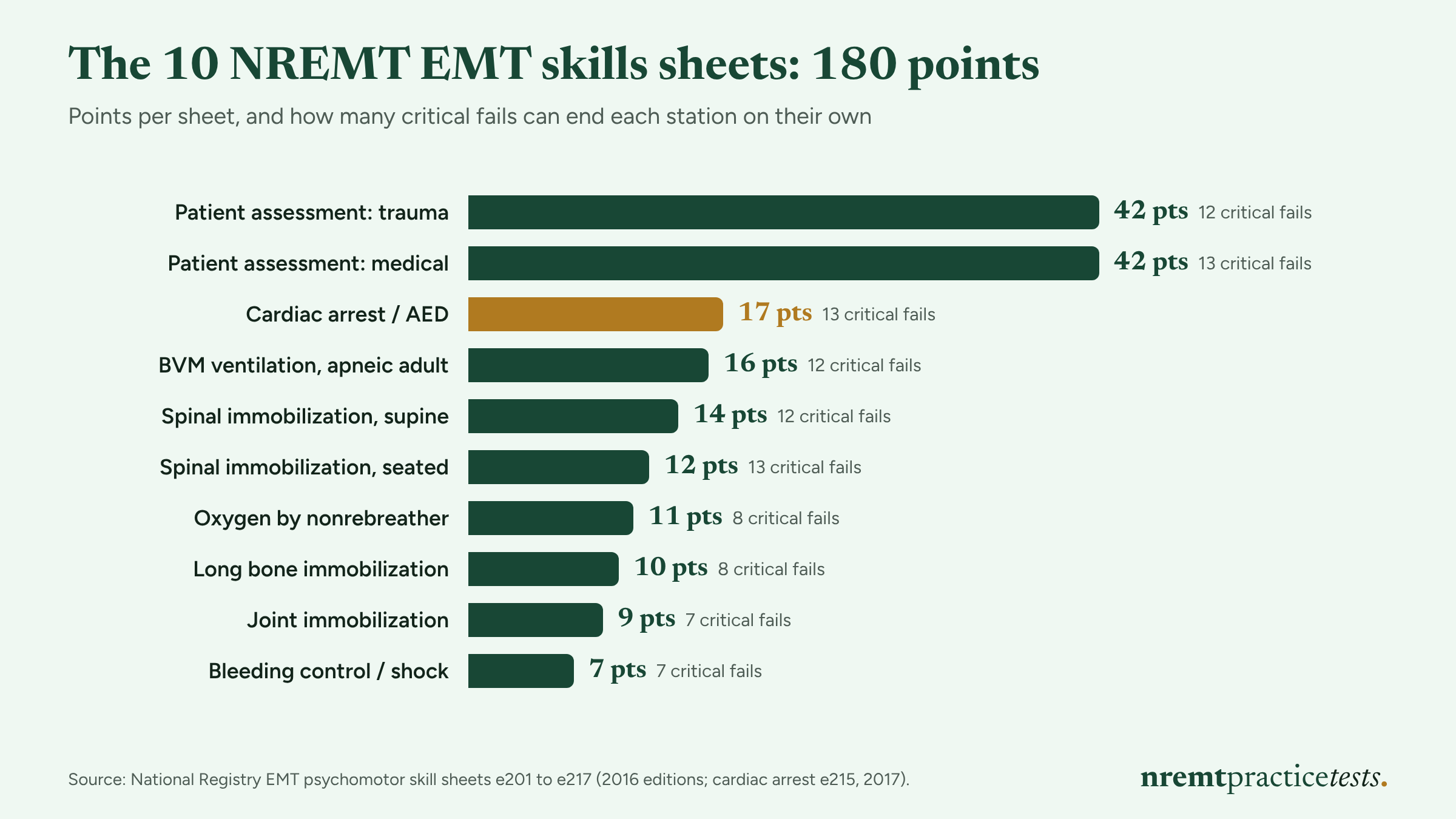
The National Registry’s EMT psychomotor exam uses 10 skills sheets, worth 180 points together, and each one ends with a list of critical criteria: a single critical fail fails that skill however many points you scored. The 2016 and 2017 editions are still free PDFs on the Registry’s content server, linked in the table below, and your state may use its own versions. The process for testing you on them is set by your state (EMR and EMT certification examinations).
This guide puts all 10 sheets in one table, then takes them one at a time: what the examiner scores, which mistakes end the station, and where a sheet differs from current guidelines. The written exam asks about the same steps, so each section points to the questions in our free NREMT practice tests that test them.
Who runs the EMT psychomotor exam in 2026?
Your state does, through its EMS office or your EMT program. The National Registry’s FAQ says the psychomotor process for EMRs and EMTs “will not change” and is “established and approved by each state”. The redesign that took effect on July 1, 2024, and ended the separate psychomotor exam, applies only to AEMTs and paramedics (EMR and EMT certification examinations).
States handle the details differently. In Virginia, for example, program directors have marked EMR and EMT students as complete for skills verification in the Registry’s system since March 1, 2026, and a missing entry can hold up your testing (Virginia Office of EMS, educator updates). Ask your program which sheets you will be tested on and who signs them off.
Points pass you. Critical fails stop you. On every sheet, one checked critical criterion fails the skill even with a perfect point count. Learn the critical list at the bottom of each sheet before the steps at the top.
All 10 EMT skills sheets in one table
Each sheet below links to the Registry’s PDF. The form codes show the edition: “10-16” means October 2016, and the cardiac arrest sheet is from July 2017.
| Sheet | Points | Critical fails | Sheet-specific critical fails to know |
|---|---|---|---|
| Patient assessment: trauma (e201) | 42 | 12 | No transport within 10 minutes; no spinal protection when indicated; any other assessment before airway, breathing and circulation |
| Patient assessment: medical (e202) | 42 | 13 | No transport within 15 minutes; secondary exam before airway, breathing and circulation; no accurate report to the arriving unit |
| Cardiac arrest management / AED (e215) | 17 | 13 | Interrupting CPR for more than 10 seconds; not clearing everyone before analysis and shock; not resuming compressions right after the shock |
| BVM ventilation of an apneic adult (e203) | 16 | 12 | Not suctioning before ventilating; no ventilation within 30 seconds of suctioning; a rate outside 10 to 12 a minute |
| Spinal immobilization, supine (e212) | 14 | 12 | Releasing manual stabilization before the head is held mechanically; securing the head before the torso |
| Spinal immobilization, seated (e211) | 12 | 13 | The same two, plus torso straps tight enough to stop the chest from rising |
| Oxygen by nonrebreather mask (e204) | 11 | 8 | Not prefilling the reservoir bag; a flow below 10 L/min; a loose mask |
| Long bone immobilization (e217) | 10 | 8 | Missing the joint above or below; hand or foot not in the position of function; no distal check before and after |
| Joint immobilization (e216) | 9 | 7 | Missing the bone above or below; no distal check before and after |
| Bleeding control / shock management (e213) | 7 | 7 | Not controlling the bleeding correctly and in time; no high-concentration oxygen; not calling for immediate transport |
The two patient assessment sheets carry almost half the points. Our medical and trauma assessment guide walks both of them line by line, so this page covers the other eight.
BVM ventilation of an apneic adult (e203)
The scenario is fixed: the patient is unresponsive, not breathing, with a weak pulse of 60, and the mouth is full of secretions and vomit. The scored order is PPE, responsiveness, call for help, a breathing and pulse check of no more than 10 seconds, open the airway, suction, insert an oral airway, then ventilate.
- Suction: insert the rigid catheter without suction applied, then suction. Suctioning “for an excessive and prolonged time” is a critical fail.
- The 30-second rules: the first breath must come within 30 seconds of suctioning, and ventilation must never stop for more than 30 seconds.
- Ventilation: bag connected to oxygen at 15 L/min, at least 85% oxygen, enough volume for visible chest rise, 10 to 12 breaths a minute.
The 2025 AHA guideline for an adult with a pulse says 1 breath every 6 seconds, which sits inside the sheet’s range. Our EMT airway management guide reconciles the two rates and adds the suction time limits by age.
Oxygen by nonrebreather mask (e204)
This 11-point sheet is a sequence: gather equipment, crack the cylinder valve, attach the regulator, open the valve, check the pressure and for leaks, attach the mask, prefill the reservoir, set at least 10 L/min, and fit the mask snugly. Beyond the three closing lines every sheet shares, it has five critical fails, and three are about getting oxygen to the mask: prefilling the reservoir, a flow of at least 10 L/min, and a tight seal.
Multiple choice, from NREMT Exam Practice 7. An alert adult with pneumonia is breathing fast but adequately, and his oxygen saturation is 85 percent. You decide to give oxygen by nonrebreather mask at 15 liters per minute. What do you do before you place the mask on his face?
A. Strap the mask in place, then turn on the oxygen
B. Set the flow at 4 liters per minute so the bag does not overfill
C. Let the reservoir bag fill with oxygen
D. Attach a humidifier, since this mask cannot be used without one
Answer: C. A full reservoir means his first breaths are high-concentration oxygen, not room air, and prefilling is a critical criterion on the sheet. A puts a tight mask with an empty bag on a man who is already short of breath. B is far too low a flow: the bag collapses each time he breathes in. D is optional for long transports, not a required step.
Cardiac arrest management / AED (e215)
The station is one rescuer with an adult in cardiac arrest. You check the scene and responsiveness, send for the AED and more help, check breathing and pulse together for no more than 10 seconds, then start compressions at once. After 2 minutes (5 cycles) of CPR, a second rescuer takes over compressions while you run the AED. The 5 points for CPR quality are depth and rate, the compression to ventilation ratio, full recoil, breath volume, and no interruption over 10 seconds.
The 2017 sheet does not print numbers for depth and rate. The 2025 AHA adult guideline supplies them, and nothing in it conflicts with the sheet (AHA 2025 adult basic life support):
- Rate: 100 to 120 compressions a minute.
- Depth: at least 2 inches (5 cm), and no more than 2.4 inches (6 cm).
- Recoil: let the chest come all the way back up. Do not lean on it.
- Ratio: 30 compressions to 2 breaths until an advanced airway is placed.
- Pulse check: no more than 10 seconds. No definite pulse means compressions.
- After a shock: resume compressions right away, with no pulse check first.
Multiple choice, from NREMT Exam Practice 7. You find a 71-year-old man in cardiac arrest, and your partner starts compressions while you open the AED. When you bare his chest, you see a firm lump about the size of a matchbox under the skin just below his right collarbone, right where the upper pad would go. What do you do?
A. Place the pad over the lump so the shock reaches his heart through the device
B. Wait for the device to deliver its own shock before you attach the AED pads
C. Place the pad at least an inch away from the lump, or use front-and-back placement
D. Do not use the AED, because a shock could damage his implanted device
Answer: C. The lump is most likely an implanted pacemaker or defibrillator, and a pad directly over it can block part of the shock. Moving the pad, or going front-and-back, lets the shock through without delay. A puts the pad on the device. B and D delay or withhold the shock, and a late shock is a critical fail on the sheet. "Follows prompts and correctly attaches AED to patient" is a scored step, and this is what correctly means here.
Cardiac arrest is the sheet our questions test most: 8 of them, including when to start compressions on a patient who is only gasping and the order of steps once the AED arrives. The primary assessment practice set holds all of them.
Bleeding control and shock management (e213)
The shortest sheet, at 7 points, follows the order of the scenario. Apply direct pressure. When the examiner says the wound is still bleeding, apply a tourniquet. When the patient shows signs of shock, position them, give high-concentration oxygen, keep them warm and call for immediate transport. Failing to control the bleeding “using correct procedures in a timely manner” is a critical fail.
The written exam pushes past the sheet. Our questions ask what to do when one tourniquet does not stop the bleeding (a second one, just above the first), where a tourniquet goes (2 to 3 inches above the wound, not over a joint) and what to do when the wound is in the groin, too close to the body for a tourniquet (pack it with hemostatic gauze and hold pressure).
Long bone and joint immobilization (e217 and e216)
The two splinting sheets differ by one rule. A long bone fracture gets the joint above and the joint below immobilized. A joint injury gets the bone above and the bone below. The long bone sheet adds one more critical fail: the hand or foot must be held in the position of function.
Both sheets start with manual stabilization and a check of distal motor, sensory and circulatory function, and both end with that check again. Skipping either check is a critical fail.
Multiple choice, from NREMT Exam Practice 7. A soccer player has a painful, deformed lower leg. Before splinting, you felt a strong pulse in the foot. You apply a padded rigid splint and secure the straps. Now you cannot find the pulse in the foot, and the toes are pale and cool. What do you do?
A. Tighten the straps further so the broken ends cannot move
B. Loosen the splint, recheck the pulse, and adjust the splint so circulation returns
C. Leave the splint as it is and report the lost pulse at the hospital
D. Raise the splinted leg above the heart and recheck the pulse in 15 minutes
Answer: B. A pulse that was there before the splint and is gone after it points to the splint, usually straps that are too tight. This is why the sheet makes the distal check after splinting a critical step. A squeezes the vessels harder. C leaves a limb without blood flow for the whole transport. D does not take any pressure off and wastes 15 minutes.
Spinal immobilization, seated and supine (e211 and e212)
Both sheets are built around one sequence: manual stabilization of the head in a neutral, in-line position, a check of motor, sensory and circulatory function in all four limbs, an appropriately sized collar, then the device. Four critical fails to know cold:
- Releasing manual stabilization before the head is held by the device.
- Securing the head before the torso is secured.
- On the seated sheet, torso straps so tight the chest cannot rise.
- No recheck of all four limbs at the end.
The sheets date from 2016: the seated sheet ends by moving the patient to a long backboard, and the supine sheet secures the patient to an immobilization device. A 2018 joint statement from the American College of Surgeons Committee on Trauma, the American College of Emergency Physicians and the National Association of EMS Physicians uses the term spinal motion restriction. It says a scoop stretcher, vacuum mattress or ambulance cot can do the same job, keeps the collar as a critical part, and says to keep time on a backboard short (Spinal motion restriction in the trauma patient, PDF). For the psychomotor station, do what the sheet scores. For the written exam, know when restriction is indicated at all.
The three critical fails on every sheet
Every EMT sheet ends with the same three lines, 30 of the 105 critical criteria across the set:
- Failure to manage the patient as a competent EMT.
- Exhibits unacceptable affect with patient or other personnel.
- Uses or orders a dangerous or inappropriate intervention.
The last one is where an action that is not on the sheet can still fail you. Pulling a deformed arm straight, or pushing a suction tip deep into the throat, will not show up as a missed step. It fails the skill as a dangerous intervention.
Which sheets the written exam tests most
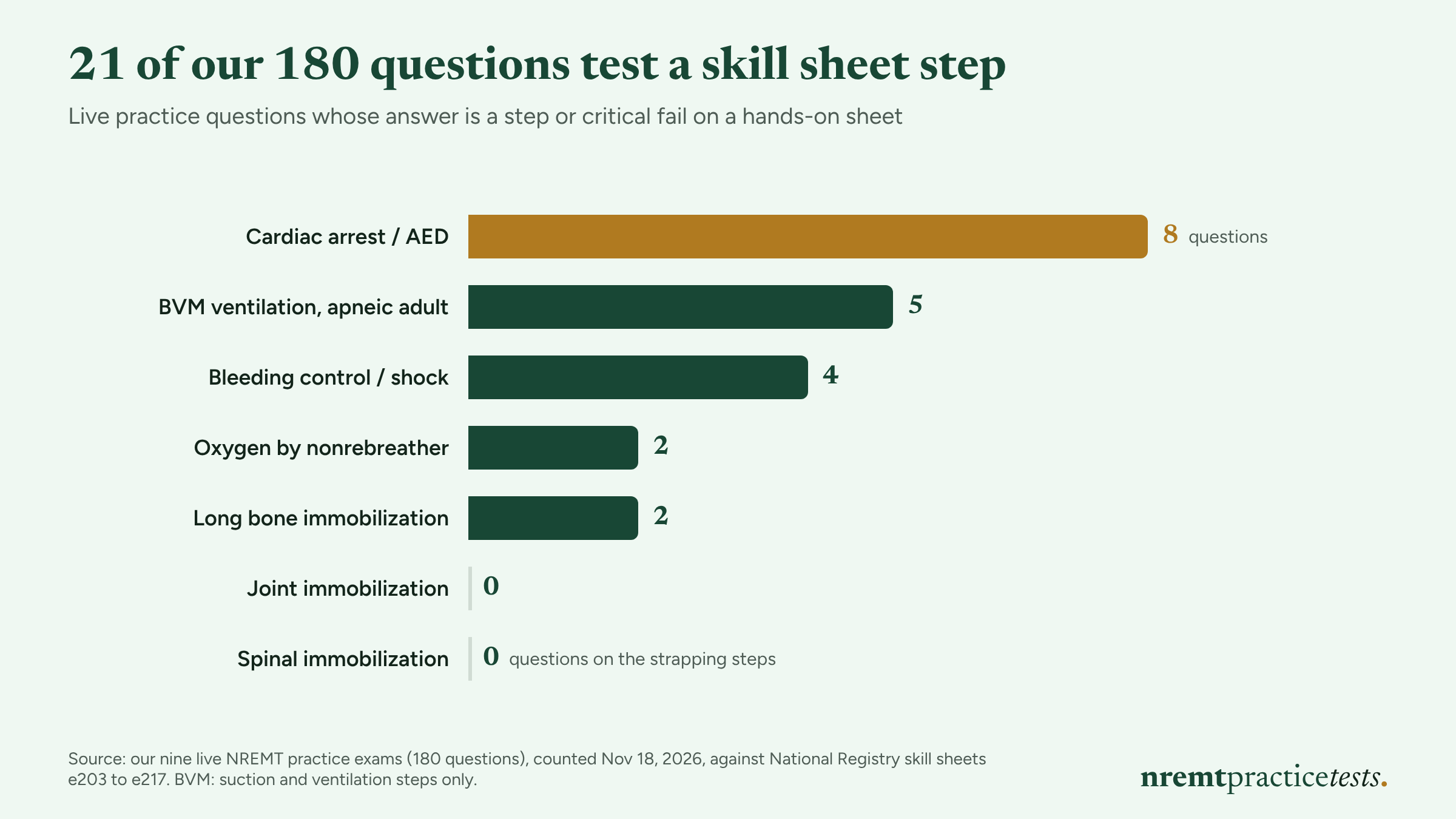
We counted every live question in our nine practice exams whose correct answer is a step or a critical fail on one of the eight hands-on sheets. 21 of 180 are, about 12%. For the BVM sheet we counted suctioning and the ventilation itself (rate, volume, chest rise), not opening the airway or inserting an adjunct, which nearly every airway question touches and our airway guide counts separately. Cardiac arrest leads with 8, then BVM ventilation with 5 and bleeding control with 4. None tests a spinal immobilization step. Our spinal questions ask when restriction is needed and what to do when a patient strapped to a board vomits, not how to strap the board.
That mix follows the written exam’s own outline. Its largest domain is primary assessment, 39 to 43% of the EMT exam, and CPR, ventilation and bleeding control are primary assessment steps. Our NREMT study guide breaks down all five domains and turns them into a 4-week plan.
Sources: the National Registry EMT psychomotor skill sheets (2016 and 2017 editions), the Registry’s EMR and EMT examinations page, the AHA 2025 adult basic life support guideline, and the 2018 joint statement on spinal motion restriction. All of them are listed on our sources page.
Frequently asked questions
How many skills sheets are there for the NREMT EMT psychomotor exam?
The National Registry has 10 EMT skill sheets: medical and trauma patient assessment, BVM ventilation of an apneic adult, oxygen by nonrebreather mask, cardiac arrest management with an AED, bleeding control and shock, seated and supine spinal immobilization, joint immobilization and long bone immobilization. Together they are worth 180 points. Which of them you are tested on, and which version of each sheet, is set by your state's process.
What is a critical fail on an NREMT skill sheet?
A critical criterion is an error that fails the skill on its own, however many points you earned. Each sheet lists them under Critical Criteria at the bottom, and the examiner must write down the reason for any one checked. Every EMT sheet ends with the same three: failing to manage the patient as a competent EMT, an unacceptable affect, and a dangerous or inappropriate intervention.
Does the National Registry still give the EMT psychomotor exam?
The Registry says the psychomotor process for EMRs and EMTs will not change and is established and approved by each state. The 2024 redesign that dropped the separate psychomotor exam applies only to AEMTs and paramedics. In some states your program now records your skills verification: Virginia moved the job of marking EMR and EMT students complete for skills verification in the Registry's system from the state EMS office to program directors on March 1, 2026.
What ventilation rate does the NREMT BVM skill sheet require?
10 to 12 breaths a minute, 1 every 5 to 6 seconds, each with enough volume to make the chest rise. The 2025 AHA guideline for an adult with a pulse says 1 breath every 6 seconds. Ventilating at 1 every 6 seconds meets both.
Are the skill sheets tested on the written NREMT exam?
Not as sheets, but the written exam asks about the same steps in scenarios. In our own bank, 21 of 180 live practice questions are keyed to a step or critical fail from the eight hands-on sheets beyond patient assessment, led by cardiac arrest and AED use with 8.
Built and maintained by the NREMT Practice Tests team. Items are original and tagged to the published EMT exam domains before they go up. Each rationale is reviewed before publish. These are study questions, not official National Registry items and not medical advice. About this site →