NREMT Study Guide 2026: What the EMT Exam Covers and a 4-Week Plan
Last updated: November 7, 2026
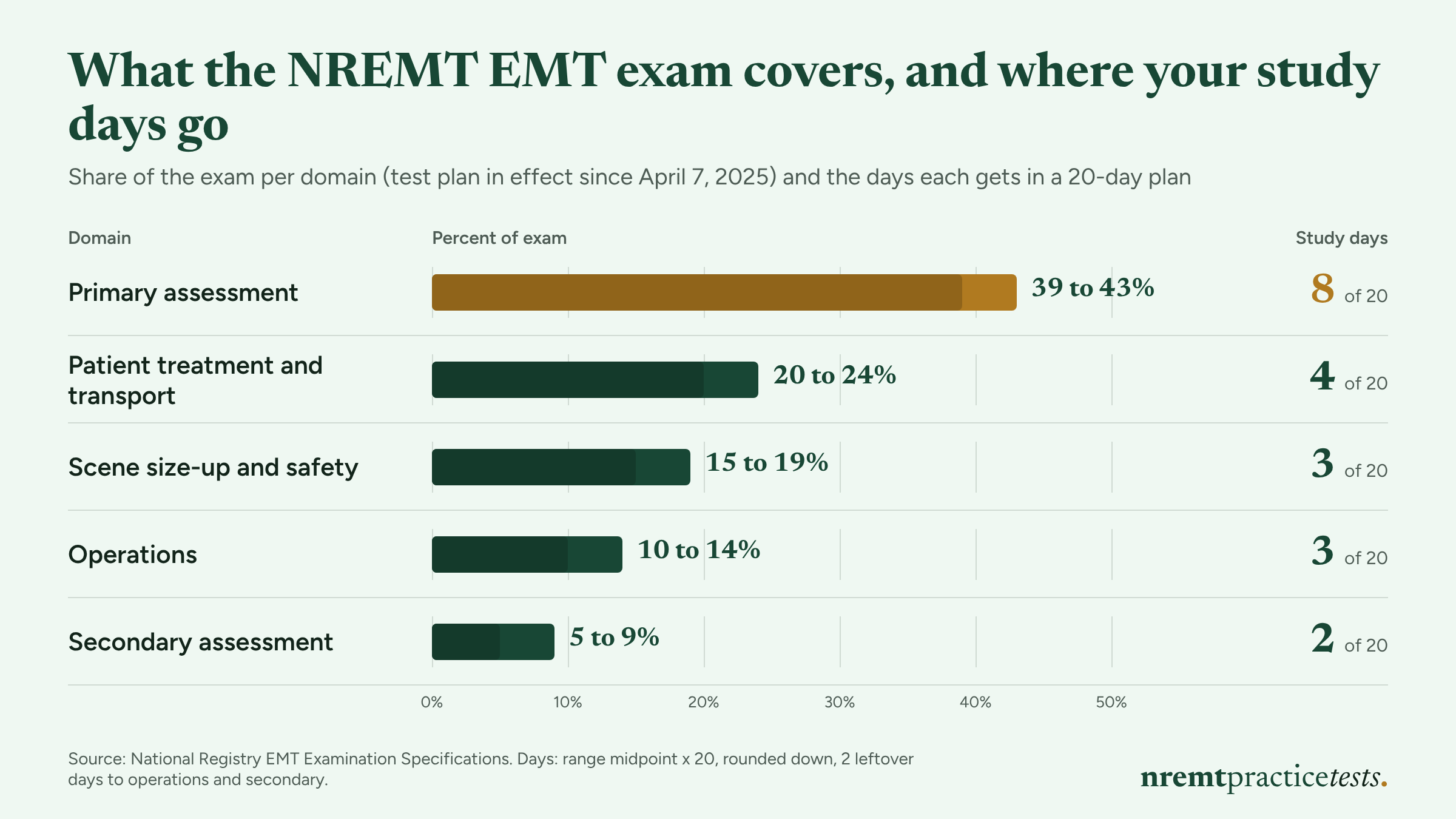
The NREMT EMT exam tests five domains, and primary assessment alone is 39 to 43% of it. The rest is patient treatment and transport (20 to 24%), scene size-up and safety (15 to 19%), operations (10 to 14%) and secondary assessment (5 to 9%), across 70 to 120 questions in 2 hours (EMT Examination Specifications).
This guide turns those weights into a 4-week plan, explains the five question types, and works three of our own practice questions in the formats that catch people out.
What changed on April 7, 2025
The National Registry replaced the EMT exam outline on April 7, 2025, based on its 2023 practice analysis of what entry-level EMTs actually do (National Registry BLS examination information). The old five domains were organized by body system: airway, respirations and ventilation; cardiology and resuscitation; trauma; medical, obstetrics and gynecology; and operations. The new five follow the order of a call.
Only operations kept its name. Pediatrics has no domain of its own: the Registry says pediatric items are integrated throughout the exam.
Check the outline before you trust a study guide. Many prep guides and search summaries still list airway, cardiology and trauma as the exam's domains. That is the outline retired in April 2025. The clinical content is still there, but it is now asked from inside an assessment or a treatment step.
The five domains and what each one asks
Each domain comes with job tasks in the test plan. This is what they mean in plain words.
| Domain | Share of exam | Job tasks in the test plan |
|---|---|---|
| Scene size-up and safety | 15 to 19% | Plan before arrival, protect everyone from hazards, choose PPE, find all the patients, triage, call for the right resources. |
| Primary assessment | 39 to 43% | Build rapport, form a general impression, check level of consciousness, airway, breathing and circulation, find the chief complaint and life threats, get baseline vitals, decide on rapid treatment, rapid transport or more resources. |
| Secondary assessment | 5 to 9% | Focused exam, interview and past history, then reassessment to catch changes. |
| Patient treatment and transport | 20 to 24% | Airway, ventilation and oxygen; circulation; motion restriction; medications; special populations; transport; handoff communication. |
| Operations | 10 to 14% | Working equipment, enough medication and supplies, complete documentation, the well-being of you and your crew. |
Notice where the familiar topics now live. Recognizing inadequate breathing is primary assessment. Ventilating the patient is treatment. Triage is a scene size-up task.
A 4-week NREMT study plan built from the weights
We gave each domain study days in proportion to the middle of its range. Twenty study days times the midpoints (41%, 22%, 17%, 12%, 7%) gives 8.2, 4.4, 3.4, 2.4 and 1.4 days. The whole days add up to 18, and we gave the 2 leftover days to operations and secondary assessment: 8 days of primary assessment, 4 of treatment, 3 of scene size-up, 3 of operations and 2 of secondary assessment. Our 20-question practice exams use nearly the same split: 8 primary assessment, 4 treatment and 2 secondary assessment questions on every exam, with 3 or 4 on scene size-up and 2 or 3 on operations.
Around the study days, each week opens with a timed practice exam and closes with a review of every question you missed.
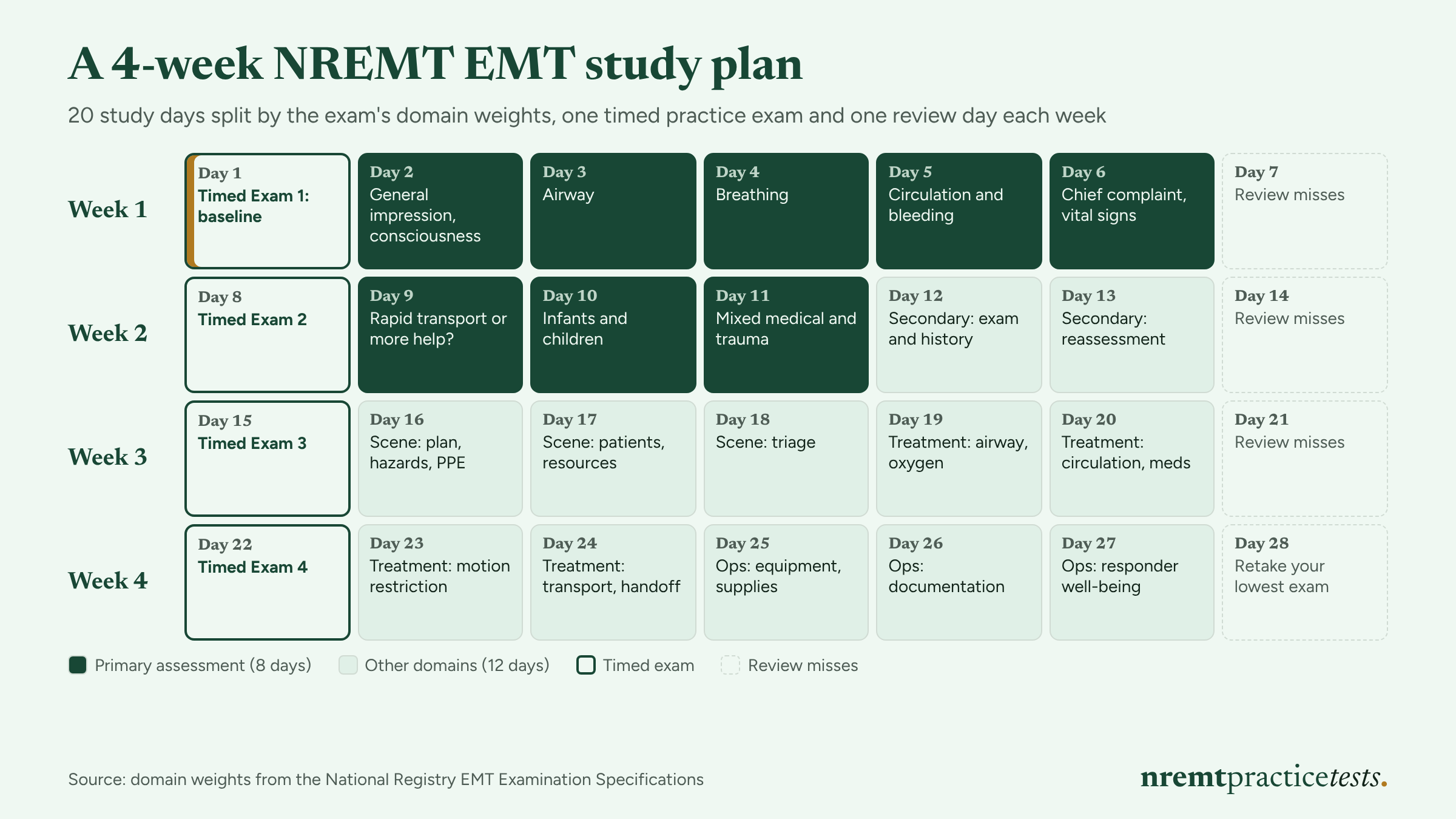
| Week | Day 1 | Days 2 to 6 | Day 7 |
|---|---|---|---|
| 1 | Timed Exam 1 as a baseline | Primary: general impression and level of consciousness; airway; breathing; circulation and bleeding; chief complaint and vital signs | Review every miss |
| 2 | Timed Exam 2 | Primary: rapid transport or more resources; infants and children; mixed medical and trauma calls. Secondary: focused exam and history; reassessment | Review every miss |
| 3 | Timed Exam 3 | Scene: plan, hazards and PPE; number of patients and resources; triage. Treatment: airway, ventilation and oxygen; circulation and medications | Review every miss |
| 4 | Timed Exam 4 | Treatment: motion restriction and special populations; transport and handoff. Operations: equipment and supplies; documentation; responder well-being | Retake your lowest exam, timed |
A study day is simple: read that topic in your course textbook, then answer practice questions on it and read the reason for every choice, including the ones you got right.
Primary assessment comes first on purpose. It is the biggest share of the exam, and the assessment order it teaches is the frame most other questions hang on. The medical and trauma assessment sequence lays that order out step by step. Pediatrics gets its own day inside primary assessment because the Registry integrates pediatric items throughout the exam.
Use the timed exams as the plan's steering wheel. If a domain scores low two weeks running, move a day to it from a domain you keep getting right. The Registry does not tell candidates their specific weaknesses, so your own practice results are the only map you get.
How the NREMT EMT exam is delivered
The exam is a computerized adaptive test. After a starting set, the computer picks items at or above its estimate of your ability, and it ends as soon as it can make a pass or fail call with 95% confidence (EMT Examination Specifications).
- Length: at least 70 items, at most 120, within 2 hours.
- Pilot items: 10 unscored questions are mixed in. They are not marked, so treat every item as scored.
- Pace: the Registry says most successful candidates spend 30 to 60 seconds per question (Examination Preparation). Two hours over 120 items works out to 60 seconds each.
- Score: if you do not pass, your score is shown on a scale from 100 to 1500, with the passing point at 950. A passing result comes without score details (EMT candidate handbook). Why 950 is not a percentage, and what happens after a failed attempt, is explained in our guide to the NREMT passing score.
Our timed mode uses the same pace: 20 questions in 20 minutes, one pass, no going back.
The five NREMT question types, including drag-and-drop
Every item on the exam is scored all or nothing. There is no partial credit for a mostly right drag-and-drop or a build list with two steps swapped.
| Type | What you do |
|---|---|
| Multiple choice | Pick the one correct answer out of four. |
| Multiple response | Pick two correct answers out of five, or three out of six. There are always three wrong options. |
| Options table | Classify each row of a table against the criteria in the columns. |
| Build list | Put the options in the order the item asks for. |
| Drag-and-drop | Drop each option into the right category. |
Count the options on a multiple-response item. The test plan fixes the shape: five options means exactly two are correct, six options means exactly three. If you have marked three out of five, one of them is wrong.
Our multiple-response items do not follow that shape. They use four to six options with two or three keys, so do not use them to practice the counting rule. The other types follow the formats described in the test plan, except that 2 of our 106 multiple-choice questions have five options instead of four.
Of the 140 questions on our seven live practice exams, 34 are in the technology-enhanced formats: 12 multiple response, 11 build list, 7 drag-and-drop and 4 options table. Fifty-six of the 140 are primary assessment, 8 on every exam.
Three worked questions in the new formats
All three are live on our practice exams. Answer each one before you read the explanation.
Options table, from NREMT Exam Practice 1. For each action, decide whether it is part of scene size-up.
1. Look for traffic and other hazards before you approach
2. Ask what medications the patient takes
3. Decide whether you need another unit
4. Listen to lung sounds in all lobes
Answer: 1 and 3 are scene size-up. 2 and 4 are not. Size-up covers hazards, the mechanism of injury or nature of illness, how many patients there are, and whether you need more help. Medications are the M in a SAMPLE history, which waits until life threats are being managed. Lung sounds are part of a patient exam, not something you do from the ambulance.
Drag-and-drop, from NREMT Exam Practice 1. Place each finding in the assessment where it belongs: the primary assessment or the secondary assessment.
Spurting blood from the wrist · A SAMPLE history · No chest rise · An OPQRST pain history
Answer: spurting blood and no chest rise go to the primary assessment. SAMPLE and OPQRST go to the secondary. The rule is that life threats are primary and history waits. Arterial bleeding gets controlled and absent breathing gets an open airway and ventilation now. SAMPLE and OPQRST describe the patient and the symptom; they do not find a life threat ([what each letter asks](/sample-history-opqrst/)). One card in the wrong bin scores the whole item wrong.
Build list, from NREMT Exam Practice 4. Your partner is doing chest compressions on an adult in cardiac arrest when you arrive with the AED. Arrange the steps for using it.
A. Attach the pads to the bare chest
B. Resume chest compressions right away
C. Tell everyone to stand clear while the AED analyzes the rhythm
D. Turn the AED on
E. Make sure no one is touching the patient, then press the shock button when advised
Answer: D, A, C, E, B. Power on first, because the voice prompts guide the rest. Pads go on the bare, dry chest while compressions continue. Everyone stands clear for the analysis and again for the shock. Then compressions resume right away for about 2 minutes, until the AED prompts the next rhythm check. The common error is stopping for a pulse check right after the shock.
What the National Registry says about preparing
The Registry’s own advice is short (Examination Preparation):
- Study your textbook and class notes, and consider workbooks.
- Review the current American Heart Association guidelines for CPR and emergency cardiovascular care. The Registry says they are tested at your level.
- It does not recommend specific study guides, and warns that some guides use easier questions than the exam. If you use one, do it a few weeks before the test and focus on your weak areas.
That last point is why every question on this site carries a reason for every choice, and why we tag each one to a domain of the current test plan. How we write and check them is on our methodology page, and the documents behind these facts are on our sources page. The other topic guides are in the study guide.
Frequently asked questions
What is on the NREMT EMT exam in 2026?
Five domains: scene size-up and safety (15 to 19%), primary assessment (39 to 43%), secondary assessment (5 to 9%), patient treatment and transport (20 to 24%), and operations (10 to 14%). This outline took effect on April 7, 2025. Pediatric items are integrated throughout the exam instead of having a domain of their own.
How many questions are on the NREMT EMT exam?
Between 70 and 120, with a 2-hour time limit. The exam is adaptive, so it stops once the computer is 95% confident of a pass or a fail. Ten of the items are unscored pilot questions, and you cannot tell which ones.
Are there drag-and-drop questions on the NREMT?
Yes. The EMT exam uses five item types: multiple choice, multiple response, options table, build list and drag-and-drop. Every item is scored all or nothing, so a drag-and-drop with one card in the wrong place earns no credit.
How long should I study for the NREMT?
The National Registry does not set a number. Its own advice is to start well in advance and to use study guides a few weeks before the exam. The plan on this page uses 4 weeks after the course ends, with a timed practice exam on day 1 to show you where to spend the time.
What score do you need to pass the NREMT EMT exam?
The exam is scored as a whole, not domain by domain. If you pass, you get no score details. If you do not pass, your score is shown on a scale from 100 to 1500, where the passing point is 950.
Built and maintained by the NREMT Practice Tests team. Items are original and tagged to the published EMT exam domains before they go up. Each rationale is reviewed before publish. These are study questions, not official National Registry items and not medical advice. About this site →