SAMPLE History for EMTs, with OPQRST: What to Ask and When
Last updated: October 28, 2026
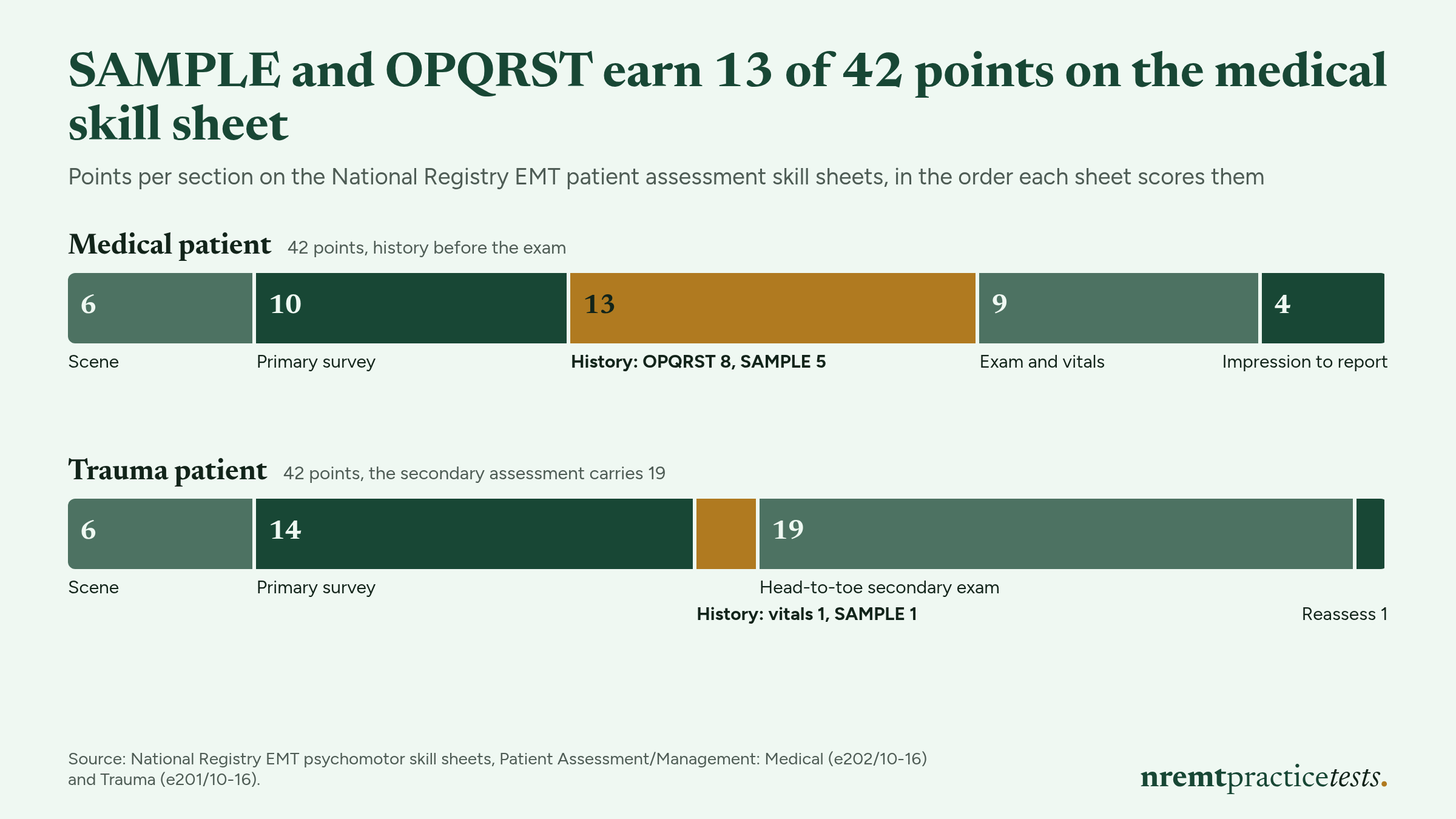
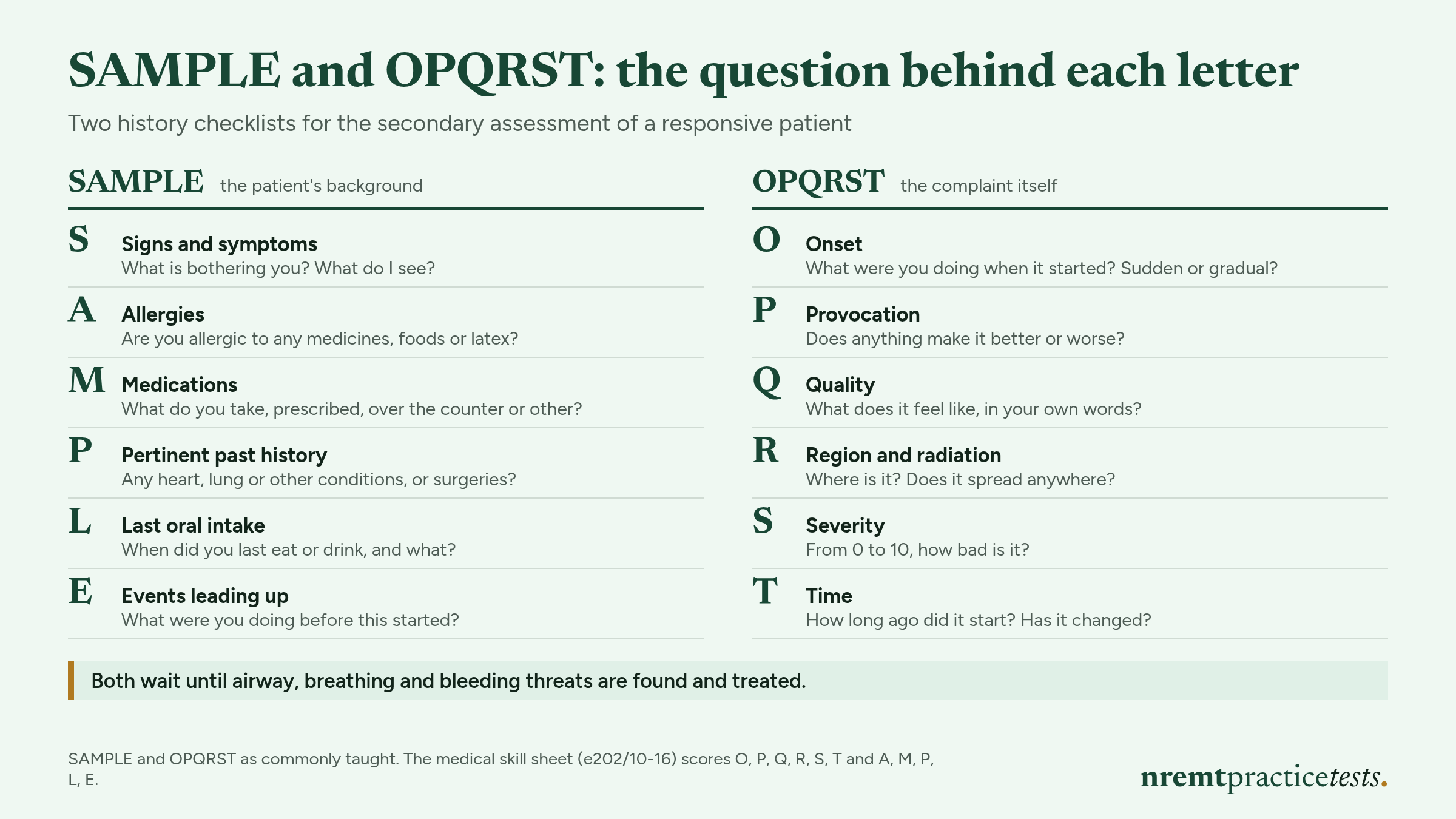
SAMPLE is the patient’s background: signs and symptoms, allergies, medications, pertinent past history, last oral intake, and events leading up. OPQRST describes the complaint itself: onset, provocation, quality, region and radiation, severity, and time. Both belong to the secondary assessment, and on the National Registry’s medical assessment skill sheet they are worth 13 of 42 points (Patient Assessment/Management: Medical, PDF).
This guide gives the question behind each letter, shows where the history sits in a medical call and a trauma call, and works three of our practice questions. It also shows the SAMPLE trap: on our first five practice exams, a SAMPLE history turns up as a wrong answer far more often than as a right one.
The question behind each SAMPLE and OPQRST letter
Use plain words. The patient does not need to hear the mnemonic, only the questions.
| Letter | What you ask | An answer that fits |
|---|---|---|
| Signs and symptoms | What is bothering you today? (Then note what you see.) | "I can't catch my breath." You see pale, sweaty skin. |
| Allergies | Are you allergic to any medicines, foods or latex? | "Penicillin gives me hives." |
| Medications | What do you take, prescribed, over the counter or anything else? | "A water pill every morning." |
| Pertinent past history | Any heart, lung or other conditions? Any surgeries? | "I had a stent put in last year." |
| Last oral intake | When did you last eat or drink, and what was it? | "A sandwich about two hours ago." |
| Events leading up | What were you doing before this started? | "Carrying boxes up the stairs." |
| Onset | What were you doing when it started? Did it come on suddenly or gradually? | "All at once, while I was watching TV." |
| Provocation | Does anything make it better or worse? | "Worse when I take a deep breath." |
| Quality | What does it feel like, in your own words? | "Like someone is stabbing me." |
| Region and radiation | Where is it? Does it spread anywhere? | "From my chest into my left arm." |
| Severity | From 0 to 10, with 10 the worst, how bad is it? | "About a 7." |
| Time | How long ago did it start? Has it changed? | "About 40 minutes ago." |
Two letters cause most of the mix-ups. The E in SAMPLE and the O in OPQRST both ask what the patient was doing. Events leading up is the story before the problem. Onset is the moment the symptom began and whether it came on suddenly or gradually. The other pair is time and onset: “40 minutes ago” is time, not onset.
Where the history fits in a medical call
The National Registry’s medical assessment sheet scores the call in this order: PPE and scene size-up, the primary survey, history taking, the secondary assessment of the affected body system, vital signs, then the field impression, interventions, reassessment and a verbal report. Its time limit is 15 minutes. Our medical and trauma assessment guide walks every step of both sheets.
History taking is the largest scored section on the sheet. Each OPQRST letter is 1 point, and clarifying questions about associated signs and symptoms add 2 more, for 8. Allergies, medications, past pertinent history, last oral intake and events leading to the present illness are 1 point each, for 5. The S in SAMPLE has no line of its own there. Signs and symptoms come in through the chief complaint and those clarifying questions.
The reason is simple. In a medical patient the history usually points to the problem. Chest pain that started while carrying boxes, spreads to the left arm and comes with a stent last year tells you more than most of the exam will.
Where the history fits in a trauma call
The trauma sheet looks very different (Patient Assessment/Management: Trauma, PDF). Its history taking section is 2 points: baseline vital signs (blood pressure, pulse and respirations) and “attempts to obtain SAMPLE history”. OPQRST is not on it. The secondary assessment (the head-to-toe exam plus wound care) is worth 19 points, and the time limit is 10 minutes.
In trauma the mechanism and the physical exam find the injuries. A patient who was thrown from a rolling car can be injured anywhere, and may not be able to tell you where it hurts.
Both sheets fail the same mistake. The medical sheet lists "performs secondary examination before assessing and treating threats to airway, breathing and circulation" as a critical failure. The trauma sheet says "performs other assessment" before those threats. A perfect SAMPLE history taken while the patient's airway is snoring fails the station.
How your skills are tested is set by your state: the Registry says the BLS psychomotor process is established and approved by each state (EMR and EMT certification examinations). The sheets still show how the Registry orders and weighs the call, and the written exam asks about the same order.
How the written exam uses SAMPLE
On the cognitive exam, history taking falls under secondary assessment, 5 to 9% of the EMT exam. The test plan describes it as investigating the patient’s condition “through focused physical assessment, interviewing, and past medical history” (EMT Examination Specifications). See the NREMT study guide for all five domains.
SAMPLE also turns up far outside that domain, as a wrong answer. We counted our own first five practice exams. Of the 90 questions that are not secondary assessment, 22 offer a choice built on taking a SAMPLE history, and in none of them is it the answer. The pattern is usually the same: a life threat or a time-critical action is on the table, and the SAMPLE choice puts history first.
- “Ask the bystanders for a SAMPLE history” when an unresponsive patient is snoring.
- “Take a SAMPLE history so the hospital knows the allergies” while an arterial bleed is still pulsing.
- “Obtain a blood pressure and a SAMPLE history, then decide on CPR” for a patient with no breathing and no definite pulse.
If a choice delays an airway, ventilation, bleeding control, CPR or a needed medication so you can ask questions, it is almost certainly the trap. History matters. It just waits, the same way a full patient exam waits during START triage.
When the patient cannot answer
An unresponsive or confused patient cannot give a reliable SAMPLE or OPQRST. Ask family, bystanders or caregivers. Look for medical identification jewelry and for medication containers. The physical exam then carries more of the weight: after a significant mechanism, a patient who cannot report pain gets a full head-to-toe exam, not a focused one.
When a different question matters more
For a suspected stroke, the most important history is the time the patient was last known to be well, because hospital treatment decisions depend on it (AHA/ASA 2026 guideline for the early management of acute ischemic stroke). Get it early, from the patient or whoever last saw them normal. The rest of SAMPLE can be gathered on the way.
Three worked questions
All three are on our practice exams. Answer each before you read the explanation.
Options table, from NREMT Exam Practice 4. During the secondary assessment of a patient with chest pain, you take a SAMPLE history. Match each statement to the part of SAMPLE it answers: allergies, medications, pertinent past history, last oral intake, or events leading up.
1. "I ate a sandwich about two hours ago."
2. "Penicillin gives me hives."
3. "I was carrying boxes up the stairs when it started."
4. "I had a stent put in my heart last year."
5. "I take a water pill every morning."
Answer: 1 last oral intake, 2 allergies, 3 events leading up, 4 pertinent past history, 5 medications. A reaction to a drug is an allergy. A prior heart procedure is past history. A diuretic taken every day is a current medication. What the patient was doing that led up to the pain is the E, events leading up. The item is scored all or nothing, so one wrong row loses it.
Options table, from NREMT Exam Practice 4. A patient has chest pain and you use OPQRST to ask about it. Match each statement to onset, provocation, quality, region and radiation, severity, or time.
1. "It's about a 7 out of 10."
2. "It feels like someone is stabbing me."
3. "It started all at once while I was watching TV."
4. "It began about 40 minutes ago."
5. "It goes from my chest into my left arm."
6. "It gets worse when I take a deep breath."
Answer: 1 severity, 2 quality, 3 onset, 4 time, 5 region and radiation, 6 provocation. Rows 3 and 4 are the pair to watch. "All at once while watching TV" is how it began, so it is onset. "40 minutes ago" is how long it has lasted, so it is time.
Multiple choice, from NREMT Exam Practice 2. A patient can follow commands, has facial droop, and arm drift. What history matters most for the hospital?
A. Give aspirin, as you would for chest pain, then transport
B. The time the patient was last known to be without these symptoms
C. Have the patient walk so you can grade the leg, then record a blood pressure
D. A full SAMPLE history, including medications, before you leave the scene
Answer: B. Last known well is the clock the hospital uses. D is the SAMPLE trap in another form: the history is appropriate, but it can be gathered on the way and it does not change the treatment window. A is wrong because the deficit may be a bleed, and C delays transport and is not how a new stroke is tested.
More secondary assessment questions are spread through Exam 1, Exam 3 and Exam 5, and every question on the site has a reason for each choice. Our methodology explains how they are written and checked, and the study guide lists the other topic guides.
Frequently asked questions
What does SAMPLE stand for in EMT?
Signs and symptoms, allergies, medications, pertinent past history, last oral intake, and events leading up to the problem. It is the patient's background, gathered in the secondary assessment once life threats are being managed.
What does OPQRST stand for?
Onset, provocation, quality, region and radiation, severity, and time. It describes the chief complaint itself, most often pain. On the National Registry medical assessment skill sheet each of the six letters is worth 1 point.
Is the SAMPLE history part of the primary or the secondary assessment?
The secondary assessment. The primary assessment finds and treats threats to the airway, breathing and circulation. Both National Registry patient assessment skill sheets place history taking after the primary survey, and starting other assessment before those threats are handled is a critical failure.
Do you use OPQRST on trauma patients?
The trauma skill sheet scores a SAMPLE history, not OPQRST, and puts the weight on the head-to-toe exam. For a responsive patient with a painful isolated injury, the OPQRST questions still describe the pain well, once life threats are managed.
How do you get a SAMPLE history from an unresponsive patient?
Ask family, bystanders or caregivers, and look for medical identification jewelry and medication containers. The patient cannot tell you where it hurts, so the physical exam carries more of the weight.
Built and maintained by the NREMT Practice Tests team. Items are original and tagged to the published EMT exam domains before they go up. Each rationale is reviewed before publish. These are study questions, not official National Registry items and not medical advice. About this site →