START Triage, Step by Step, with JumpSTART and SALT
Last updated: October 21, 2026
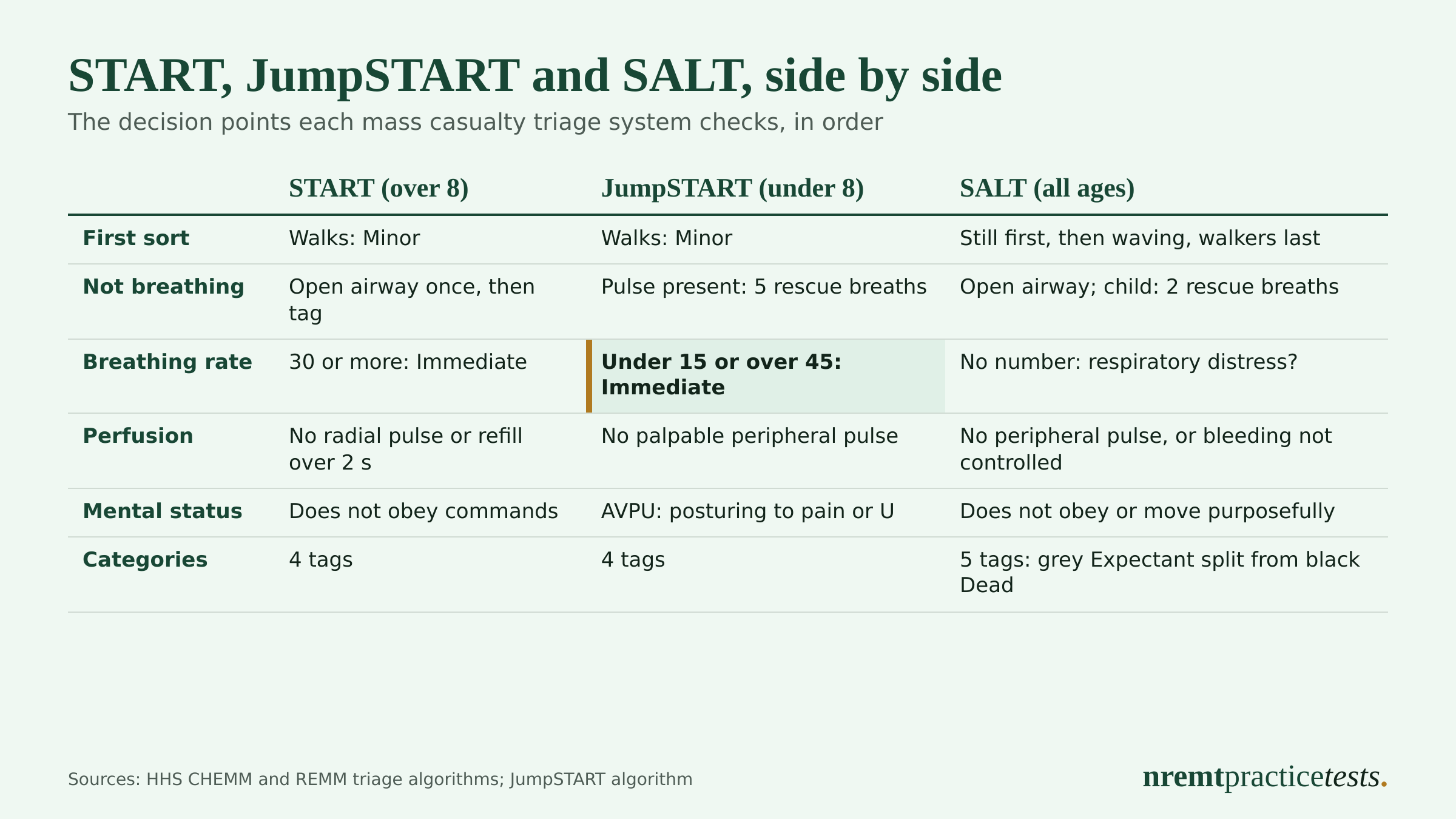
START triage (Simple Triage and Rapid Treatment) sorts mass casualty patients with a few quick checks: can they walk, are they breathing, is the rate 30 or more a minute, do they have a radial pulse, and can they obey a command. Walkers are Minor (green). A non-walker who fails a check is Immediate (red), one who passes all of them is Delayed (yellow), and one who does not breathe after you open the airway is Expectant (black).
That is the adult tool. Children get JumpSTART, which changes the breathing cutoffs, the pulse check and the apnea rule, and many systems now teach SALT, which adds a step before the tag and a fifth category. This guide runs the three side by side, then puts the same six patients through each one so you can see exactly where they disagree.
START triage, step by step
START was created in 1983 by the Newport Beach Fire and Marine Department and Hoag Hospital in California. A 1996 revision swapped capillary refill for the radial pulse as the main perfusion check, and HHS still describes START as the most used mass casualty triage algorithm in the US (CHEMM, REMM). It is meant for patients who appear older than 8.
- Walk. Call out: anyone who can walk, go to a named spot. Everyone who walks is Minor (green). You come back to them later.
- Breathing. Not breathing? Open the airway once. Breathing now is Immediate. Still not breathing is Expectant (black). No CPR in START.
- Rate. 30 or more a minute is Immediate. Under 30, keep going.
- Perfusion. No radial pulse, or a capillary refill over 2 seconds, is Immediate. Control major bleeding as you pass.
- Mental status. Cannot follow a simple command such as “squeeze my hand” is Immediate. Follows it: Delayed (yellow).
START has one breathing number: 30. Some summaries add a low cutoff, but the HHS START chart asks one rate question: is it under 30? If not, the patient is Immediate. Once a patient trips any check, you tag Immediate and move on. You do not finish the list.
What the triage tag colors mean
START and JumpSTART use four categories. SALT uses five, because it separates the patient who is dead from the one who is alive but unlikely to survive with what you have on scene (CHEMM SALT).
| Tag | Category | What it means |
|---|---|---|
| Red | Immediate | Airway, breathing or circulation is compromised. Needs care and transport within minutes to survive. |
| Yellow | Delayed | Serious, possibly life-threatening injuries, but not expected to deteriorate over several hours. |
| Green | Minor (SALT: Minimal) | The walking wounded. Unlikely to deteriorate over days and may help with their own care. |
| Black | Expectant (START, JumpSTART) or Dead (SALT) | START and JumpSTART: in the algorithm, only a patient still not breathing after the airway is opened (in JumpSTART, also after rescue breaths if a pulse is present). SALT: dead only. |
| Grey | Expectant (SALT only) | Alive, but not expected to survive given the injuries and the resources on scene. Comfort care and pain relief. |
JumpSTART: what changes for children
JumpSTART is the pediatric version of START, developed in 1995 and updated in 2001, for patients who appear younger than about 8 (CHEMM JumpSTART). Same order, different physiology:
- Walk. Walkers are Minor. An infant who cannot walk yet is not sorted out at this step and goes through the whole algorithm.
- Not breathing. Position the airway. Breathing now is Immediate. Still apneic: check for a palpable pulse. No pulse is Expectant. A pulse earns 5 rescue breaths. Breathing after them is Immediate. Still apneic is Expectant.
- Rate. Under 15 or over 45 is Immediate. 15 to 45, keep going.
- Perfusion. No palpable peripheral pulse is Immediate.
- Mental status, by AVPU. Alert, responds to voice, or withdraws from pain is Delayed. Posturing to pain or unresponsive is Immediate.
The rescue breaths are the biggest practical difference. Under the adult rule, an apneic patient who does not breathe after one airway maneuver is tagged Expectant. Under JumpSTART, an apneic child who still has a pulse gets a trial of ventilation first. Pediatric airway and newborn questions, with a reason under every choice, are in our third practice exam.
SALT: treat first, then tag
SALT stands for Sort, Assess, Lifesaving interventions, Treatment and/or Transport. It was developed in 2008 as a national all-hazards standard for every age, meets the CDC Model Uniform Core Criteria for mass casualty triage, and is endorsed by groups including the American College of Emergency Physicians and the National Association of EMS Physicians (CHEMM SALT).
- Sort globally. Ask people to walk to a spot, then ask the rest to wave. Assess the still and obviously injured first, the wavers second, the walkers last.
- Lifesaving interventions: control major hemorrhage, open the airway (2 rescue breaths for a child), chest decompression if trained, antidotes if available. These come before the tag, and the whole individual assessment should take under a minute per patient.
- Assess. Not breathing is Dead (black). Otherwise four yes or no checks: obeys commands or moves purposefully, has a peripheral pulse, breathing without distress, major hemorrhage controlled.
- Tag. All four yes: Minimal (green) if the injuries are minor, Delayed (yellow) if not. Any no: Immediate (red) if the patient is likely to survive with current resources, Expectant (grey) if not.
SALT has no breathing number. It asks whether the patient is in respiratory distress. It also asks a question START never does: is this patient likely to survive with what we have right now?
Six patients through all three systems
The tables above look similar. The tags they produce are not always the same. Here are six patients, worked step by step through each algorithm.
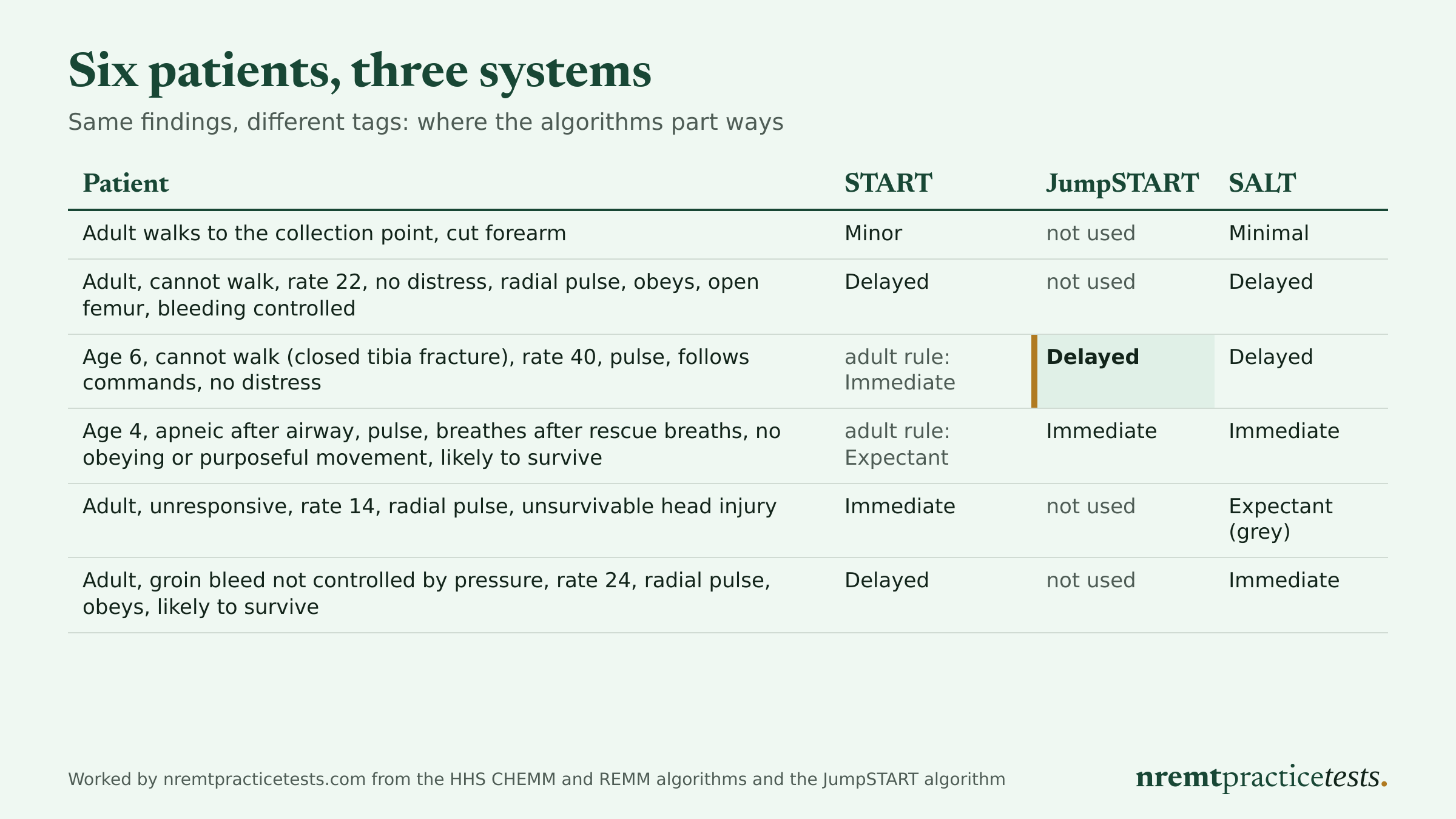
| Patient | START | JumpSTART | SALT | The deciding step |
|---|---|---|---|---|
| Adult walks to the collection point with a cut forearm | Minor | Not used | Minimal | START: walking alone makes them Minor. SALT: walking only puts them last in line; they are Minimal because all four checks are yes and the injury is minor. |
| Adult cannot walk, rate 22, no distress, radial pulse, obeys, open femur fracture with bleeding controlled | Delayed | Not used | Delayed | Passes every START check. SALT: all four checks yes, injuries not minor, so yellow. |
| Age 6, cannot walk (closed tibia fracture), rate 40, peripheral pulse, follows commands, no distress | Not used (the adult cutoff would say Immediate) | Delayed | Delayed | 40 is inside JumpSTART's 15 to 45 range. The adult rule of 30 would tag Immediate. SALT: no distress, injuries not minor, so yellow. |
| Age 4, apneic after the airway is positioned, pulse present, breathes after the rescue breaths (2 in SALT, 5 in JumpSTART), does not obey commands or move purposefully, judged likely to survive | Not used (the adult rule would say Expectant) | Immediate | Immediate | Rescue breaths: 5 in JumpSTART, 2 in SALT. START gives none. SALT: a "no" plus likely to survive is Immediate. |
| Adult unresponsive, rate 14, radial pulse, head injury judged unsurvivable | Immediate | Not used | Expectant (grey) | START tags by physiology only. SALT asks about survival with current resources. |
| Adult bleeding from the groin despite pressure, rate 24, radial pulse, obeys, judged likely to survive | Delayed | Not used | Immediate | SALT checks whether major hemorrhage is controlled, and a "no" plus likely to survive is Immediate. START has no bleeding criterion for the tag: you control bleeding as you pass, but it does not change the tag. |
Two of the six change tag between START and SALT. On an exam, read which system the question names. If it says START, use START’s checks exactly, even where SALT would decide differently.
Where triage sits on the NREMT EMT exam
In the EMT test plan that took effect in April 2025, “Triage patients to ensure optimal care” is listed as a job task under Scene Size-up and Safety, a domain worth 15 to 19% of the exam (EMT Examination Specifications). The test plan does not name a triage system.
So learn START and JumpSTART cold, with every number, and know SALT well enough to recognize it, because your course and your local protocols may teach it. Triage questions tend to test three things: the order of the checks, the cutoffs, and the discipline to tag and move on instead of treating the first patient you reach. The full breakdown of what we test follows the same five domains.
Worked examples from our practice exams
Both of these are live items. Try them before reading the answer.
From NREMT Exam Practice 1. You are the first unit at a bus crash. Many people are walking and some are on the ground. The scene is safe. What do you do before a full assessment of one person?
A. Load the quietest person, obtain vital signs, and start oxygen in the ambulance
B. Ask anyone who can walk to move to a collection point, then triage the people who cannot
C. Wait for more units to arrive before beginning triage
D. Tag the people who can walk as minor, then start a full secondary exam on the first one
Answer: B. You sort the group before you commit to one patient. Walkers are tagged minor, then the rest are sorted by respirations, perfusion and mental status. C is the trap: you request more units during size-up, but you do not wait for them. The scene is safe, so triage of the people who cannot walk starts now. D starts a full exam on a walker while the people on the ground are still unsorted.
From NREMT Exam Practice 2. At a bus crash, a person walks to your collection area when you ask anyone who can walk to move. Which START tag applies?
A. Green, minor
B. No tag, because walking patients are not part of the incident
C. Red, immediate, because they were in a bus
D. Black, expectant, because you have not counted respirations yet
Answer: A. Walking on command makes the patient minor. They still get a tag so they are not lost, and you come back to them in secondary triage. The vehicle does not set the tag, and in the START algorithm the only route to black is a patient who is still not breathing after the airway is opened.
Both exams are free, 20 questions each, with a reason under every choice. The full list of practice tests and the study guide are the next stops, and the references behind every rationale are on our sources page.
Frequently asked questions
What does START stand for in triage?
Simple Triage and Rapid Treatment. It was created in 1983 by the Newport Beach Fire and Marine Department and Hoag Hospital in California, and HHS describes it as the most used mass casualty triage algorithm in the United States.
What are the steps of START triage?
Walk, breathing, respiratory rate, perfusion, mental status. Anyone who can walk is Minor. A patient who cannot walk is Immediate if they breathe only after you open the airway, breathe 30 or more times a minute, have no radial pulse or a capillary refill over 2 seconds, or cannot obey a simple command. A patient who passes every check is Delayed, and one who does not breathe after the airway is opened is Expectant.
How is JumpSTART different from START?
JumpSTART is for patients who appear younger than about 8. It uses a breathing range of 15 to 45 instead of the adult cutoff of 30, checks any palpable peripheral pulse, scores mental status with AVPU, and gives 5 rescue breaths to an apneic child who still has a pulse before assigning Expectant.
What does SALT triage stand for?
Sort, Assess, Lifesaving interventions, Treatment and/or Transport. It was developed in 2008 as a national all-hazards standard for patients of all ages, and it adds a fifth category so that Expectant (grey) is separate from Dead (black).
What do the triage tag colors mean?
Red is Immediate: a threat to airway, breathing or circulation that needs care within minutes. Yellow is Delayed: serious injuries that can wait hours. Green is Minor: the walking wounded. Black is Expectant in START and JumpSTART. In SALT black means Dead and grey means Expectant, a patient unlikely to survive with the resources on scene.
Built and maintained by the NREMT Practice Tests team. Items are original and tagged to the published EMT exam domains before they go up. Each rationale is reviewed before publish. These are study questions, not official National Registry items and not medical advice. About this site →